

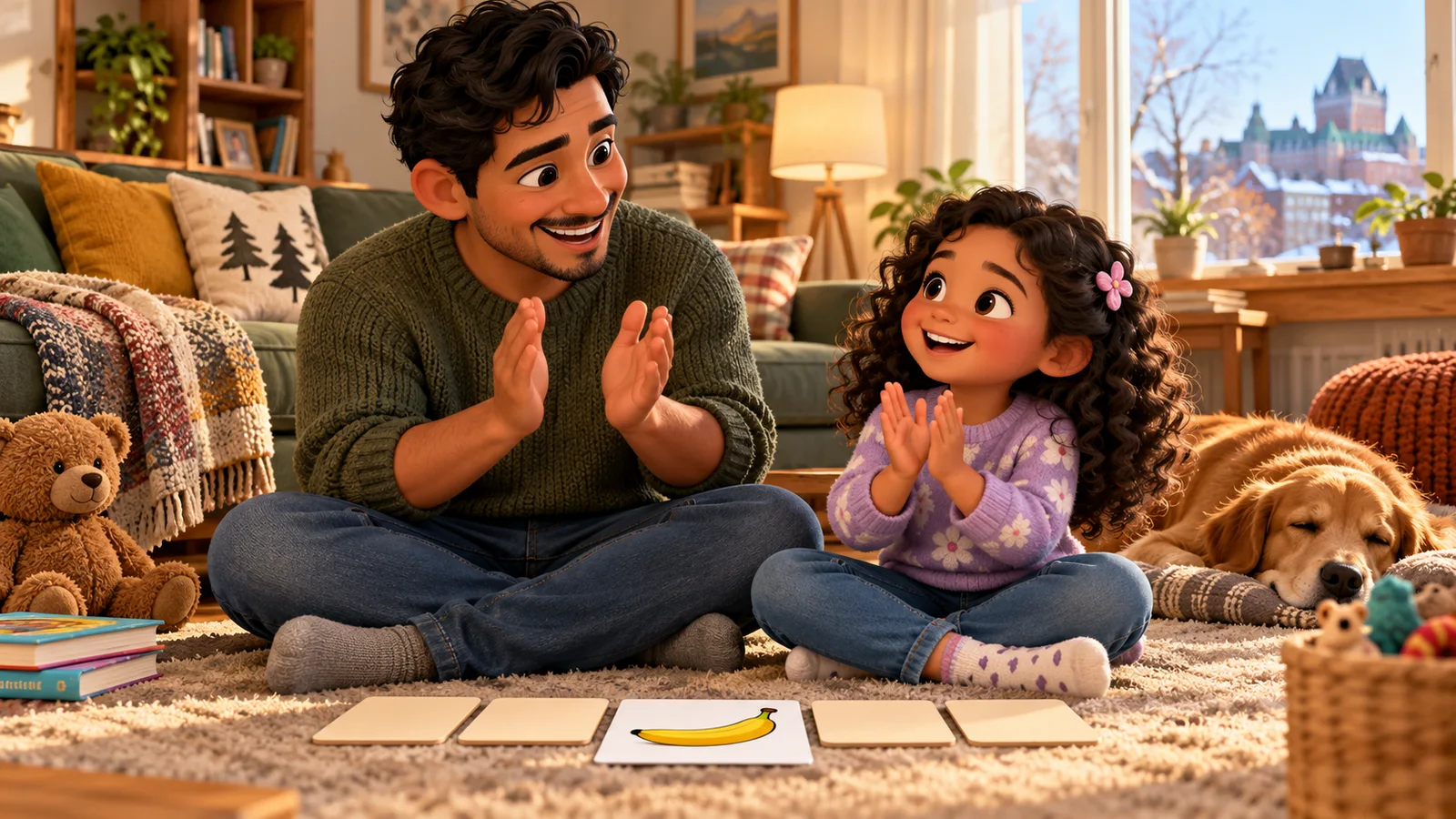
To practise syllables with a beginning reader, first listen to familiar spoken words, then distinguish that activity from reading written letters. Clapping twice does not show that a child can read the word. These short activities separate spoken syllables, smaller speech sounds and early decoding.
Start with what you hear
Say “sun” naturally and clap once. Say “rabbit” and clap for rab-bit: two beats. Keep the printed words out of sight at first so the activity concerns listening rather than spelling.
The Institute of Education Sciences explanation of phonological awareness distinguishes syllables from smaller sound units. “How many syllables?” is therefore a different question from “Which individual sounds do you hear?”
Activity 1: sort spoken words
Say each word and let your child place one counter for each syllable heard.
| Spoken word | Suggested division | Counters |
|---|---|---|
| sun | sun | 1 |
| rabbit | rab-bit | 2 |
| picnic | pic-nic | 2 |
| banana | ba-na-na | 3 |
Use your normal pronunciation. If you disagree, repeat the word slowly together rather than treating a pronunciation difference as a spelling mistake. Avoid complicated examples whose syllable count varies across speakers when introducing the task.
Activity 2: blend spoken parts
Say “rab,” pause briefly, then “bit.” Ask which word the parts make. Try pic + nic next. Keep written cards hidden to preserve the listening focus.
Reverse roles so your child divides a word for you to guess. If they create an invented word, discuss the sounds without pretending it is a dictionary word. The sound task and word meaning can be checked separately.
Activity 3: connect sounds with print
Use only letter–sound correspondences your child has learned. For sun, say its three phonemes and blend them while pointing to s, u and n. Sun has one syllable but three phonemes in this example. That does not conflict with the single clap from the first activity.
The IES foundational reading guide treats sound awareness and decoding as connected but distinct tasks. Follow your child’s classroom sequence; this brief article is not a complete phonics program.
Keep observations separate
Record what your child can do orally and what they can read in print. Success in one task does not automatically imply success in the other. If difficulty continues, share specific examples with the teacher instead of assigning a diagnosis yourself.
For books that fit your child’s current decoding knowledge, use our beginning-reader book guide. Reading comprehension is another goal, and you can discuss meaning while reading aloud even when a child cannot yet decode the whole passage.