


To teach a child to tell time on an analogue clock, distinguish the hour and minute hands first. Then practise whole hours, half hours and quarter hours. This sequence includes answers and can be adjusted to what your child has already learned in class.
Understand what each hand shows
On a conventional clock, the shorter hand indicates hours and the longer hand indicates minutes. One complete turn of the minute hand takes 60 minutes. Each numbered interval represents five minutes, so moving from 12 to 1 adds five minutes.
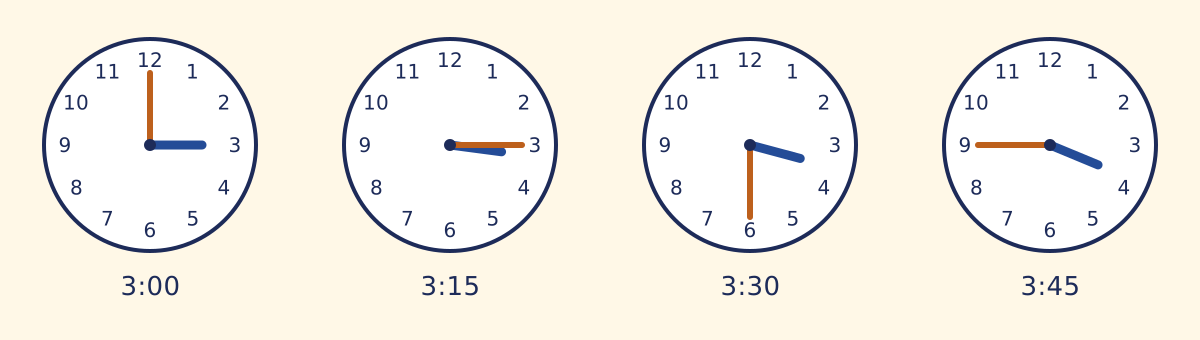
The hour hand also moves gradually. At 3:30 it is between 3 and 4, not exactly on 3. The original diagram below uses a shorter blue hour hand and a longer orange minute hand.
First: whole hours
Put the minute hand on 12 and move the hour hand to 2, 5 and 8. The answers are 2:00, 5:00 and 8:00. A twelve-hour clock face alone does not show morning or evening; the context supplies that information.
If your child mixes up the hands, ask them to identify each hand before reading a time. A movable cardboard clock can make it easier to discuss what changes.
Next: half hours
Put the minute hand on 6 and the hour hand halfway between 4 and 5. The time is 4:30, or half past four. The minute hand pointing to 6 means 30 minutes, not six minutes.
Try again with the hour hand between 7 and 8: 7:30. Move both hands to show the gradual change between hours rather than jumping the hour hand only when the minute hand reaches 12.
Then: quarter hours
The minute hand on 3 indicates 15 minutes; on 9 it indicates 45 minutes. 3:15 is quarter past three. 3:45 is also quarter to four. Keep the numerical form first if “quarter to” introduces too much at once.
Four exercises with answers
- Minute hand on 12, hour hand on 9: 9:00.
- Minute hand on 6, hour hand between 1 and 2: 1:30.
- Minute hand on 3, hour hand just after 10: 10:15.
- Minute hand on 9, hour hand between 5 and 6, close to 6: 5:45.
Ask your child to explain the minute-hand clue and then the hour-hand clue. For an afternoon time, 3:30 p.m. is 15:30 in twenty-four-hour notation. Introduce that link separately if reading the hands is still demanding.
Connect time to an event
An activity starts at 3:00 and ends at 3:30, so it lasts 30 minutes. Show the movement of the minute hand instead of subtracting clock readings as though they were decimal numbers.
Follow the actual lesson and the Quebec Education Program for the learning sequence expected in class. Our word problem activities provide other opportunities to draw and explain a situation before calculating.