

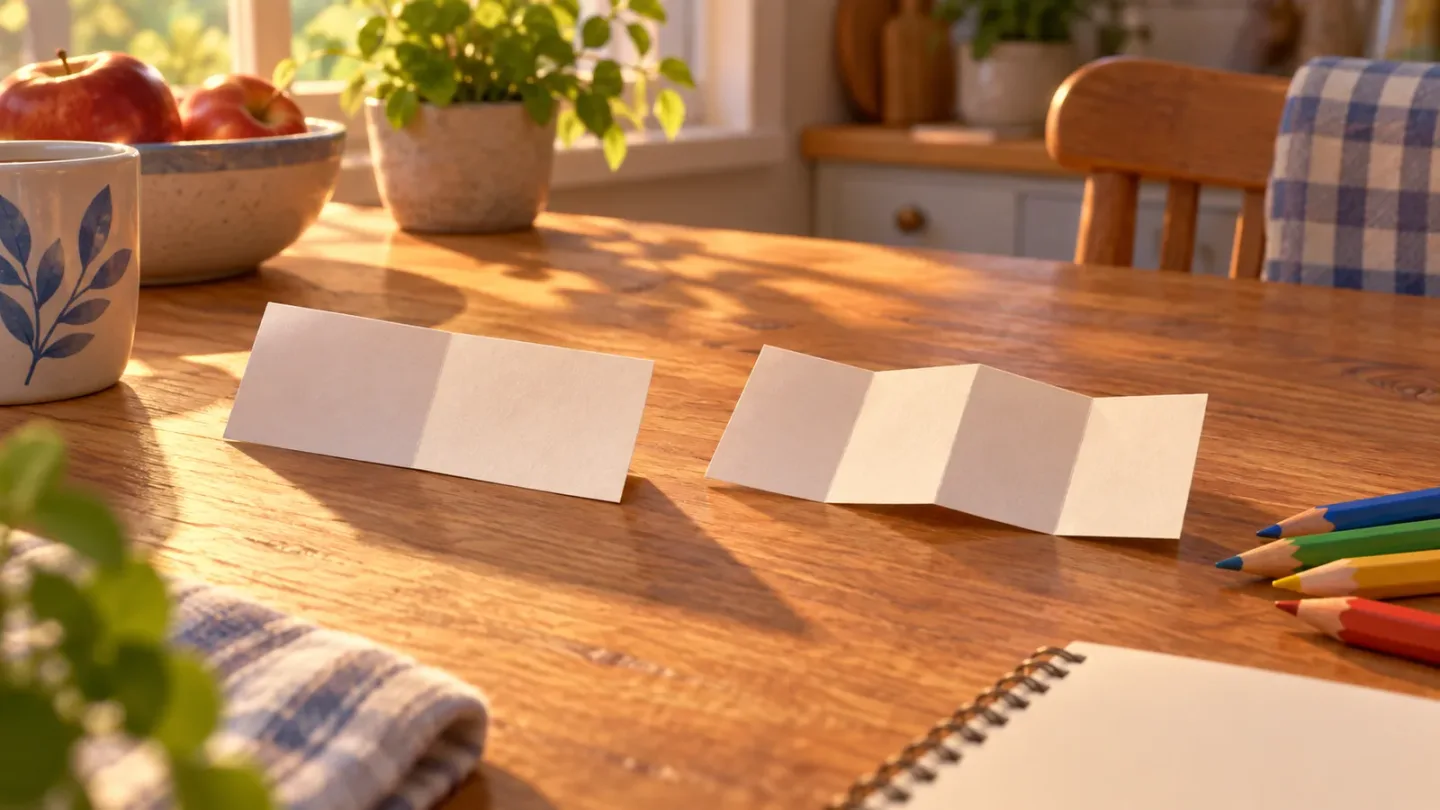
To help an elementary-school child understand fractions, define the whole and divide it into equal parts. Then represent a fraction with paper or objects. Before comparing two fractions, check that they refer to the same whole. These three activities can be adapted to your child’s school lesson.
Identify the whole and its parts
In 3/4, the denominator, 4, tells us how many equal parts the whole is divided into. The numerator, 3, tells us how many of those parts are being considered. Ask, “What is our whole?” A complete sheet and a set of eight counters are different wholes.
Alloprof’s elementary fraction representation guide covers fractions of a whole and of a collection. The guide is in French. Begin with the representation used at school before trying another one.
Activity 1: fold a paper strip
Cut a rectangular strip and fold it into two equal parts. Open it and colour one part: you have represented 1/2 of the strip. Ask your child to show the whole, then the coloured part.
Fold another strip of the same length into four equal parts. Colour one part and name 1/4. Line up the strips to compare the coloured sections. One quarter is smaller than one half when the wholes are identical. If one strip is longer, the visual comparison can mislead you; remake the strips at the same size.
Activity 2: find a fraction of a collection
Put eight counters on the table. They form the whole. Split them into four groups of two. One group is 1/4 of eight, or two counters. Three groups are 3/4 of eight, or six counters.
Ask, “Does the 4 mean four counters or four equal groups?” Here, it means four equal groups. Rebuild the entire collection after each question so you do not change the whole without explaining it.
Next, try twelve counters divided into three equal groups. One third of the collection is four counters. Let your child move the objects before writing an answer.
Activity 3: explore equivalent fractions
Take two identical strips. Colour half of the first and two quarters of the second. Line them up: the coloured length is the same. You have represented 1/2 = 2/4. Alloprof’s equivalent fractions guide, in French, explains this relationship as representing the same part of a whole.
Ask, “What changed? What stayed the same?” The number and size of the parts changed; the amount represented stayed the same. Keep the strips available to check the answer before introducing a calculation rule.
Three questions with answers
- A strip has four equal parts. Three are coloured. What fraction is coloured? 3/4.
- A collection contains twelve counters. How many represent half? Six, because each of two equal groups contains six counters.
- On a strip identical to the first, how many quarters must you colour to show half? Two quarters, or 2/4.
Ask your child to draw or build each answer. If they say 1/4 is larger than 1/2 because 4 is larger than 2, return to the identical strips. Compare the size of one part in each division.
Connect the activity to schoolwork
Finish with a workbook question that resembles an activity your child completed. Ask them to name the whole before calculating. If they still struggle, note whether the difficulty involves equal parts, reading the fraction or making comparisons, then share that example with their teacher.
For another topic you can explore with objects, see our times tables guide.