
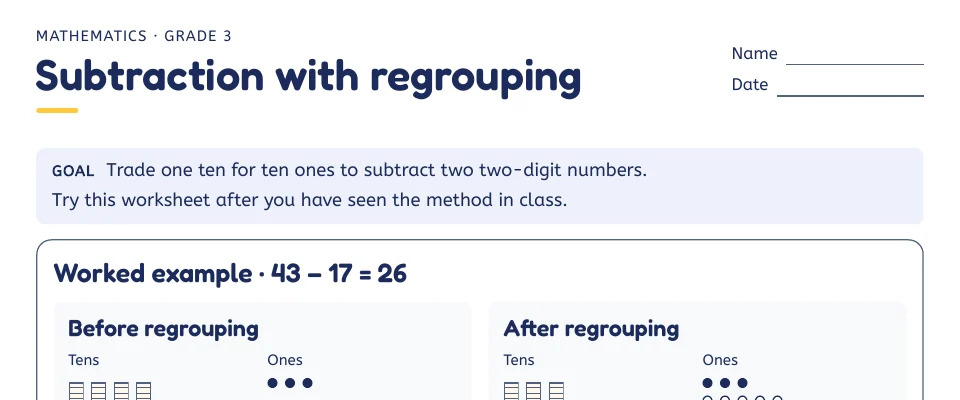
Subtraction with regrouping
Study the worked example 43 − 17, then try nine questions on two-digit subtraction. Use this worksheet after seeing regrouping in class.
View exercisePrintable worksheets with answer keys for practice at home, in French and English.
Study the worked example 43 − 17, then try nine questions on two-digit subtraction. Use this worksheet after seeing regrouping in class.
View exercise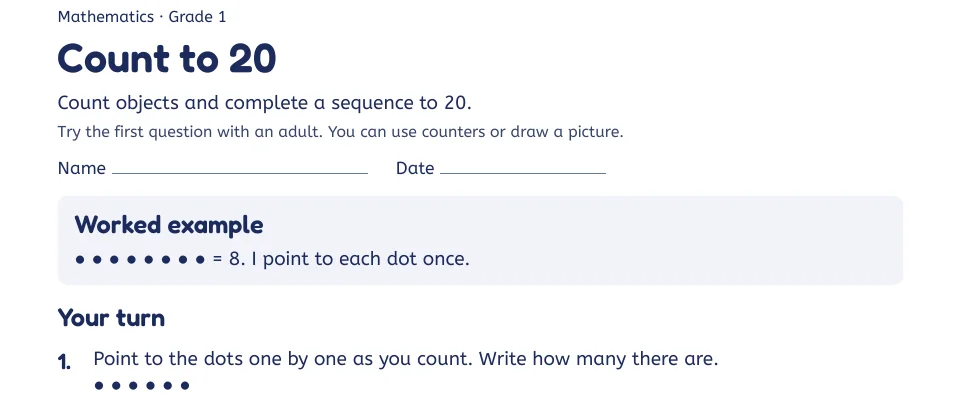
Count objects and complete a sequence to 20.
View exercise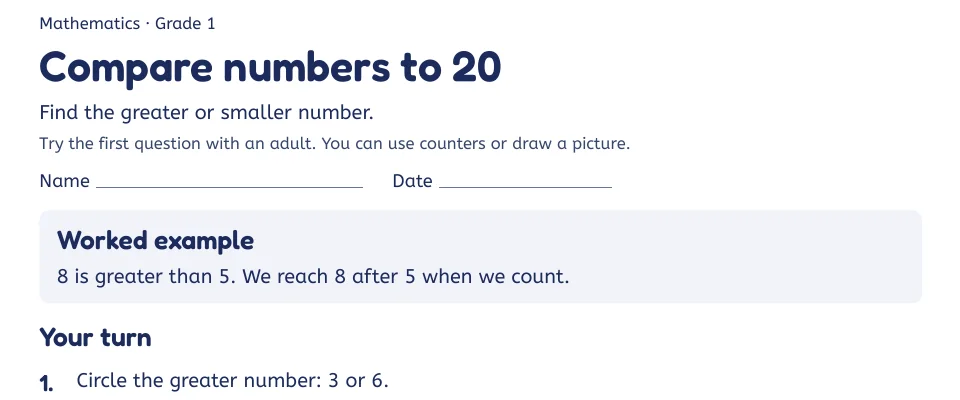
Find the greater or smaller number.
View exercise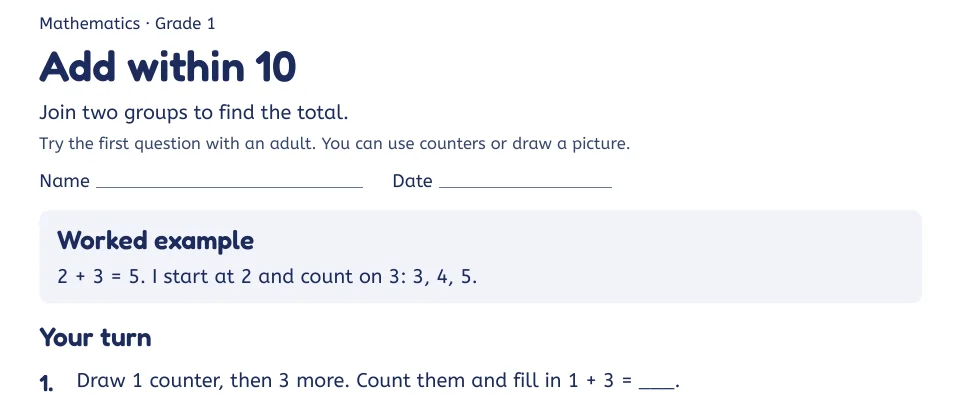
Join two groups to find the total.
View exercise
Take objects away and count what is left.
View exercise
Break a two-digit number into tens and ones.
View exercise
Add two-digit numbers using a drawing.
View exercise
Draw tens and ones to take away an amount.
View exercise
Measure a length without gaps or overlaps.
View exercise
Regroup ten ones as one ten.
View exercise
Write a multiplication for equal groups.
View exercise
Share objects equally with nothing left over.
View exercise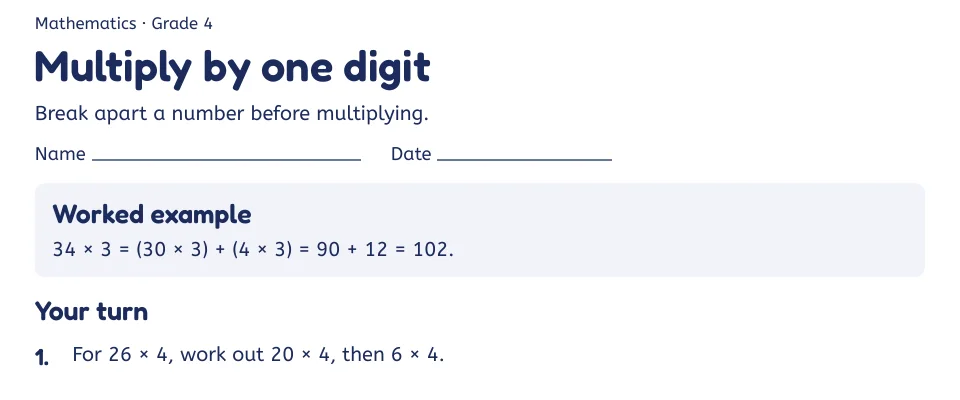
Break apart a number before multiplying.
View exercise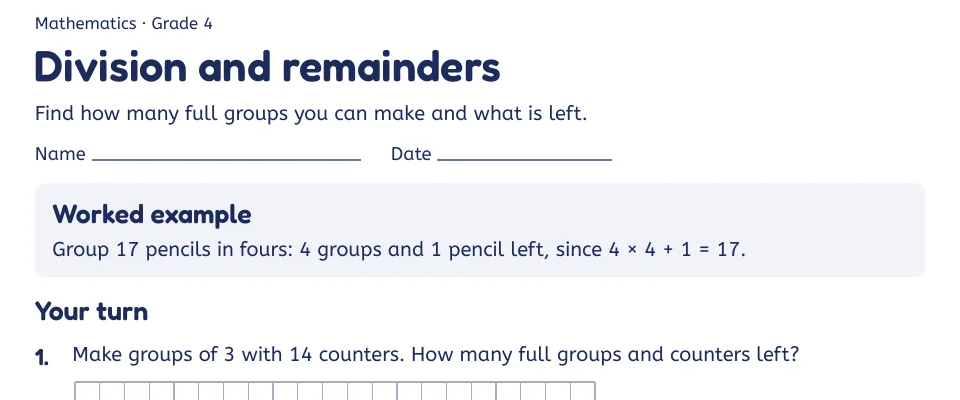
Find how many full groups you can make and what is left.
View exercise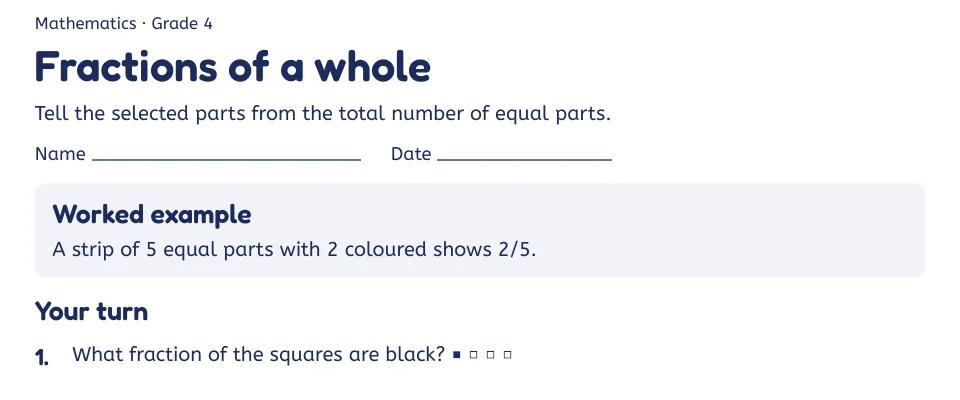
Tell the selected parts from the total number of equal parts.
View exercise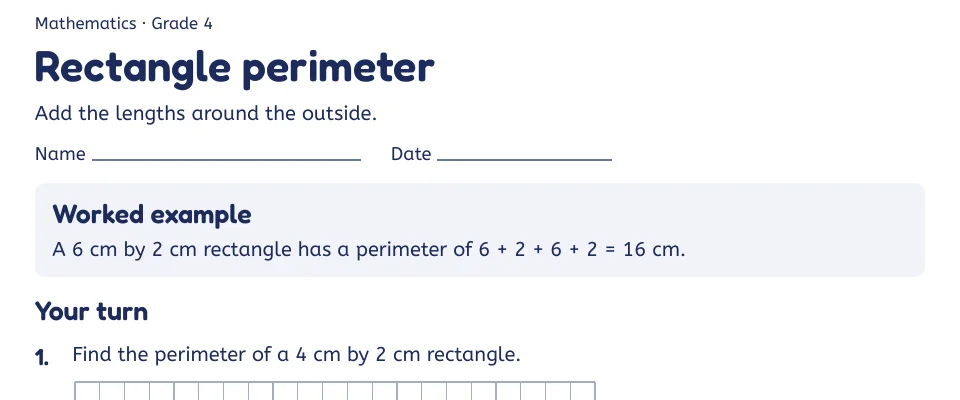
Add the lengths around the outside.
View exercise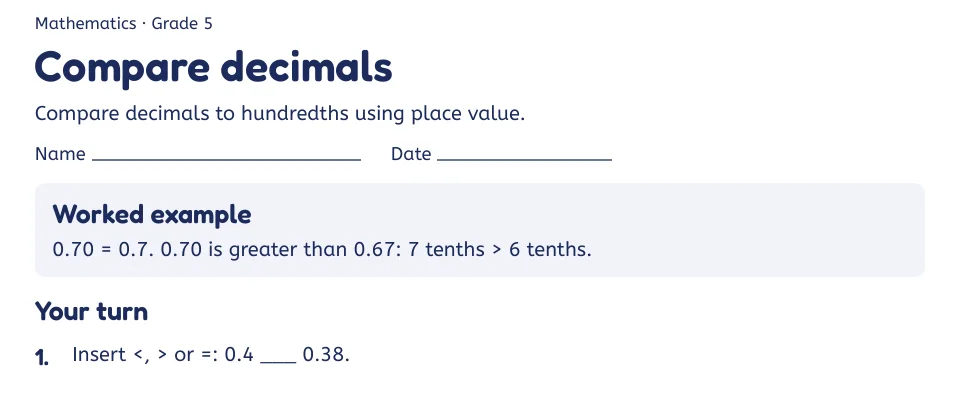
Compare decimals to hundredths using place value.
View exercise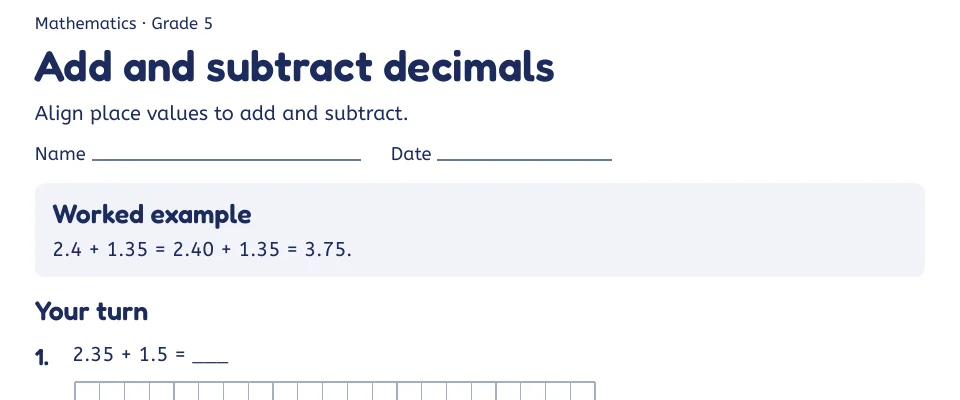
Align place values to add and subtract.
View exercise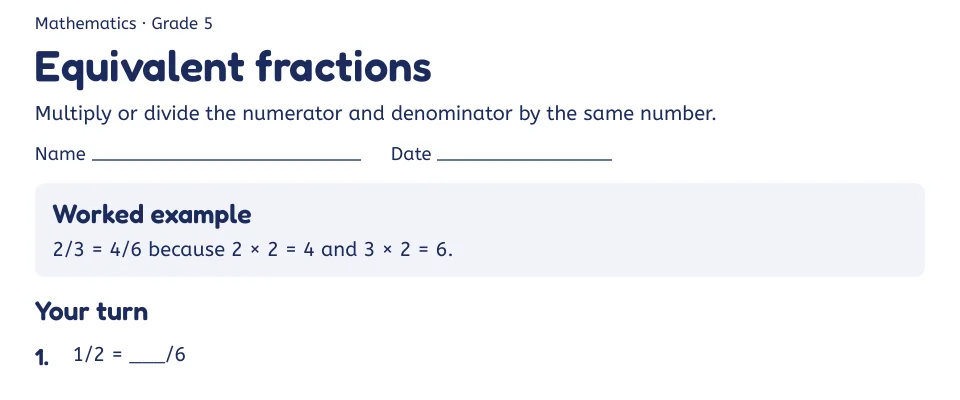
Multiply or divide the numerator and denominator by the same number.
View exercise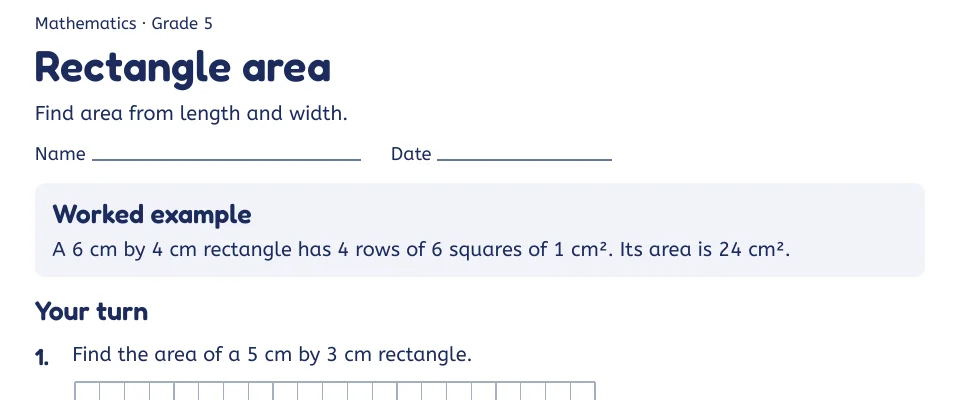
Find area from length and width.
View exercise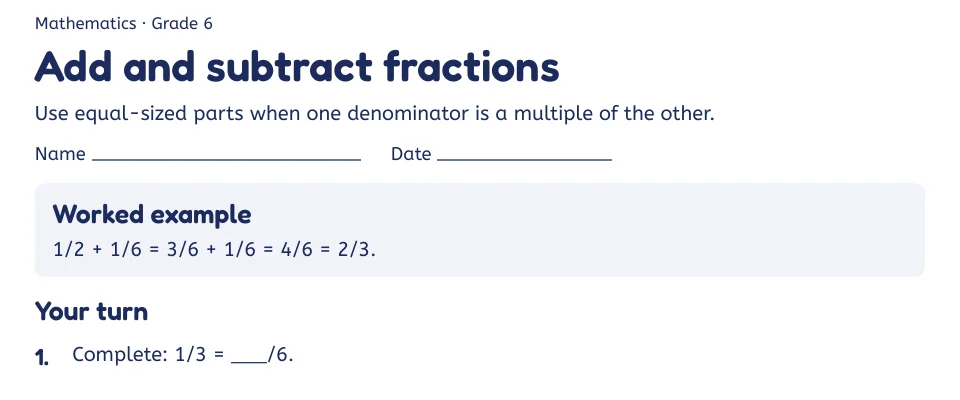
Use equal-sized parts when one denominator is a multiple of the other.
View exercise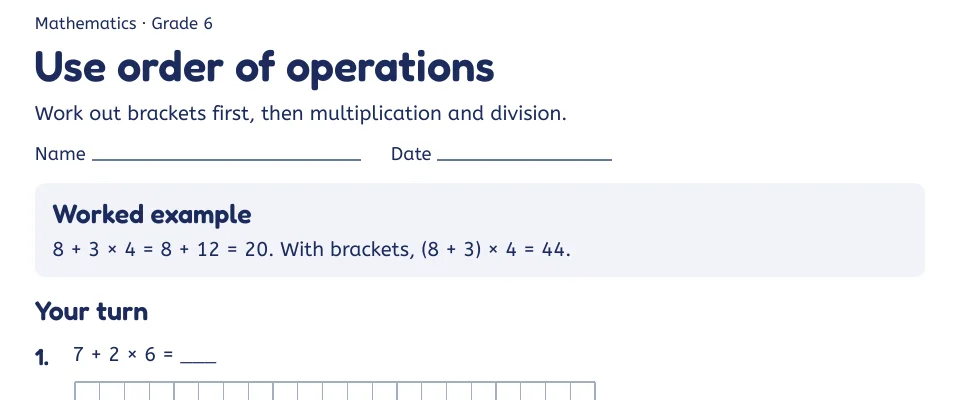
Work out brackets first, then multiplication and division.
View exercise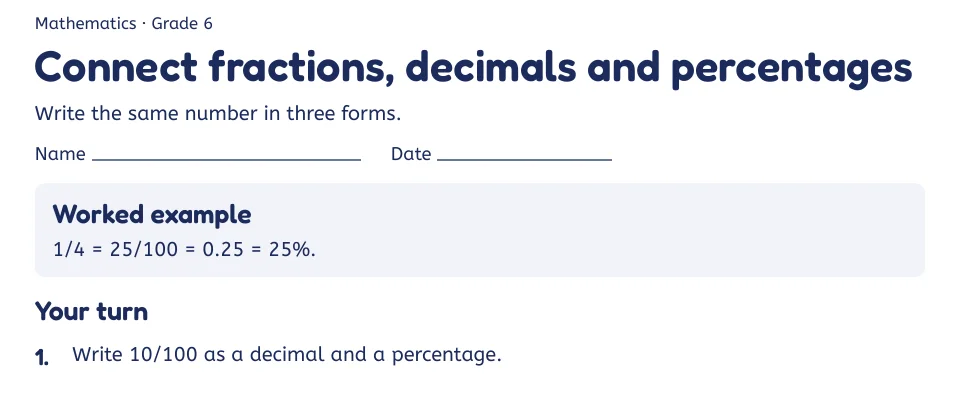
Write the same number in three forms.
View exercise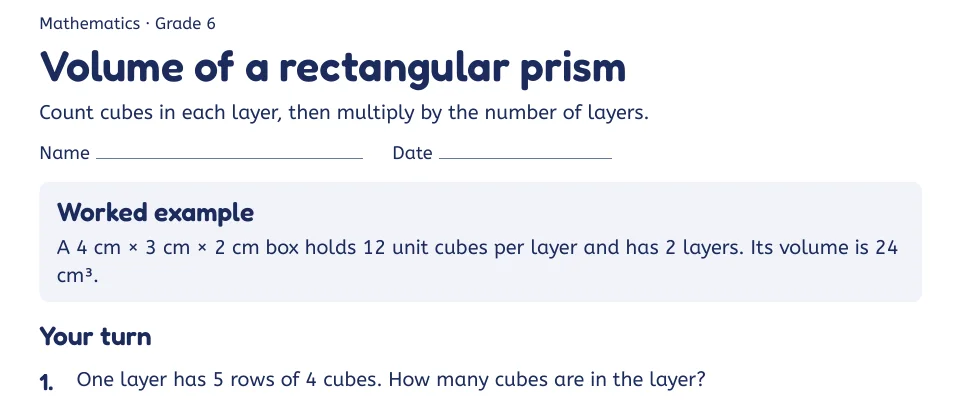
Count cubes in each layer, then multiply by the number of layers.
View exercise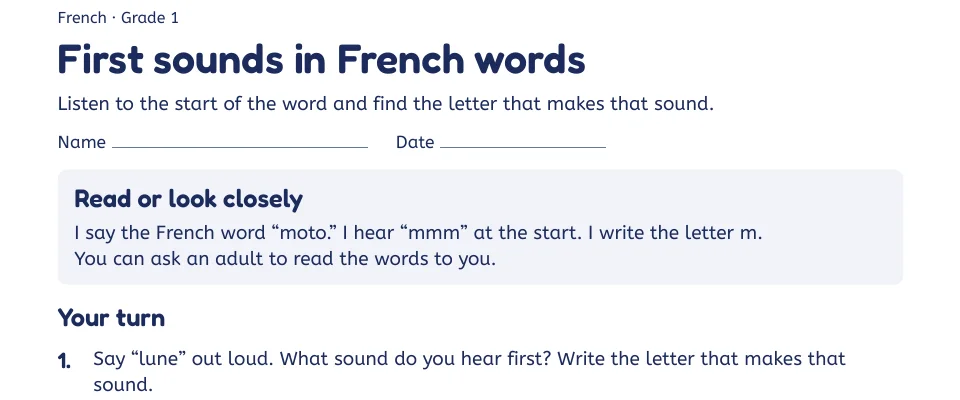
Listen to the start of the word and find the letter that makes that sound.
View exercise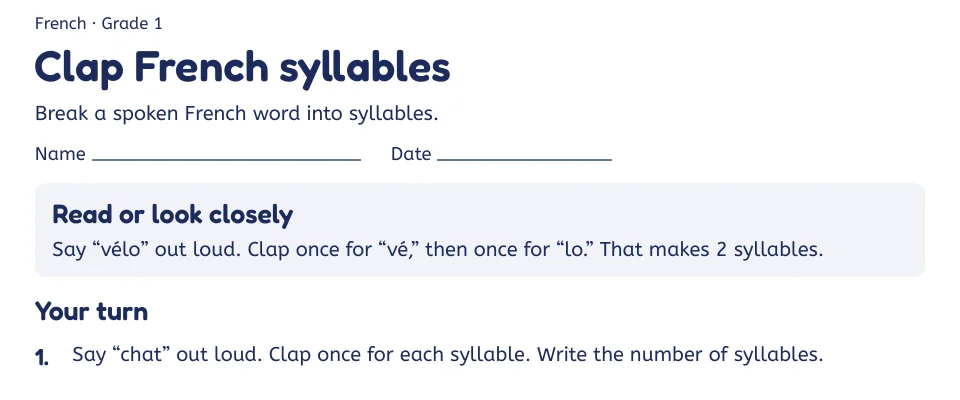
Break a spoken French word into syllables.
View exercise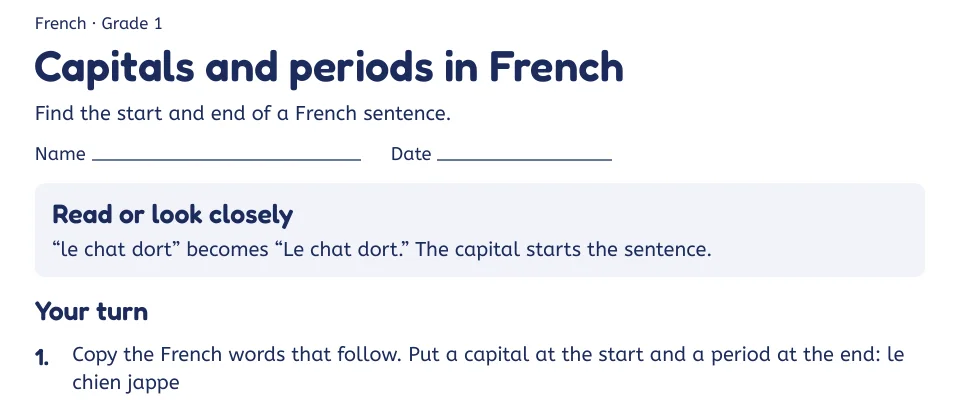
Find the start and end of a French sentence.
View exercise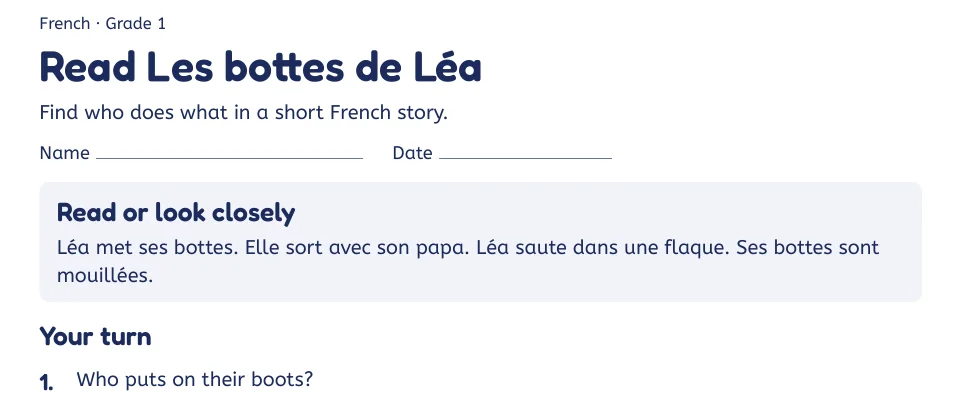
Find who does what in a short French story.
View exercise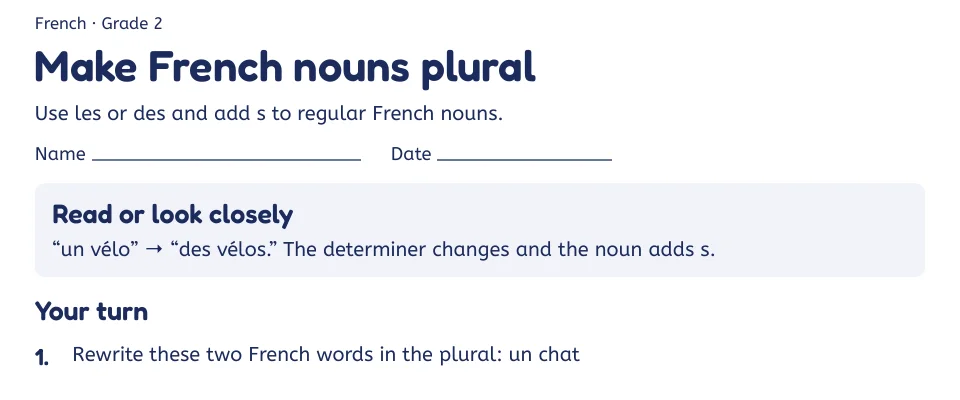
Use les or des and add s to regular French nouns.
View exercise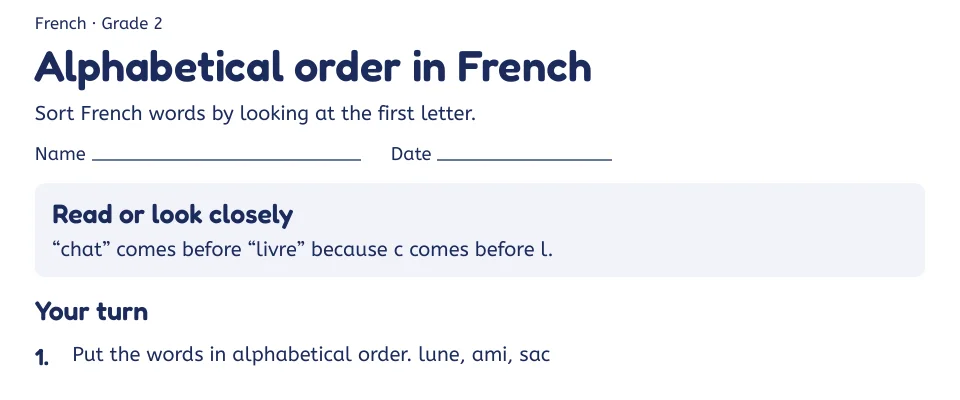
Sort French words by looking at the first letter.
View exercise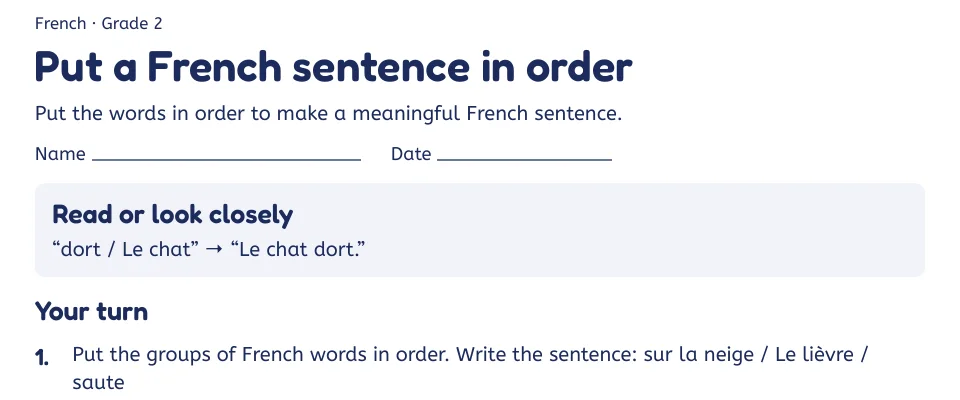
Put the words in order to make a meaningful French sentence.
View exercise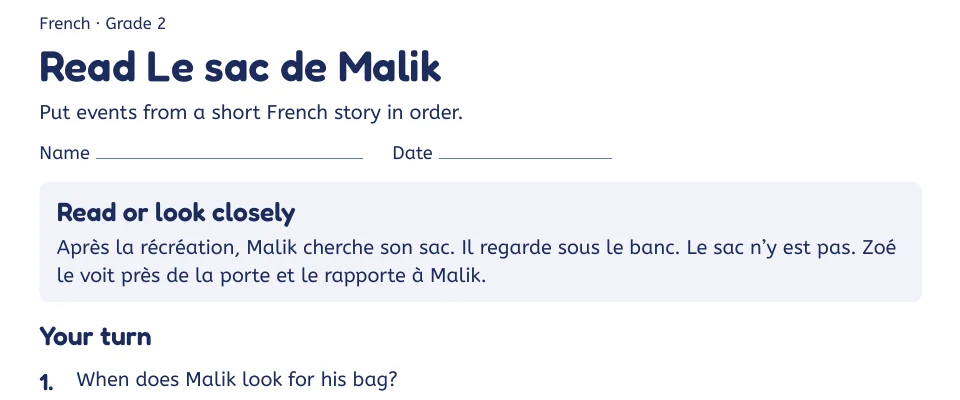
Put events from a short French story in order.
View exercise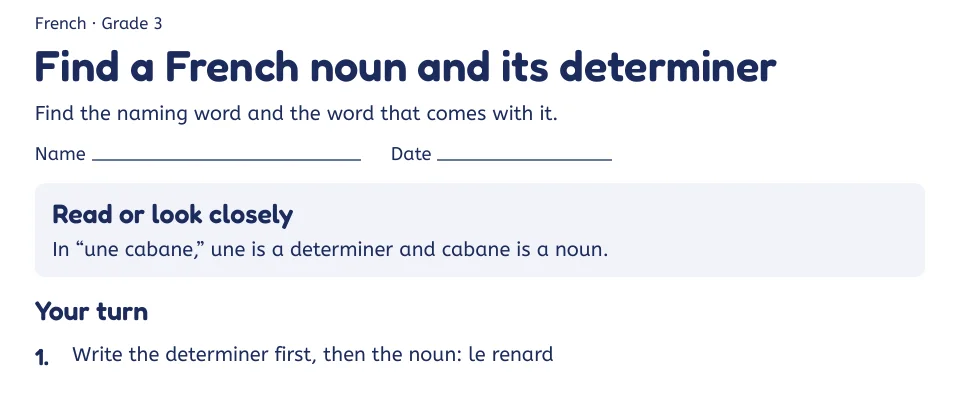
Find the naming word and the word that comes with it.
View exercise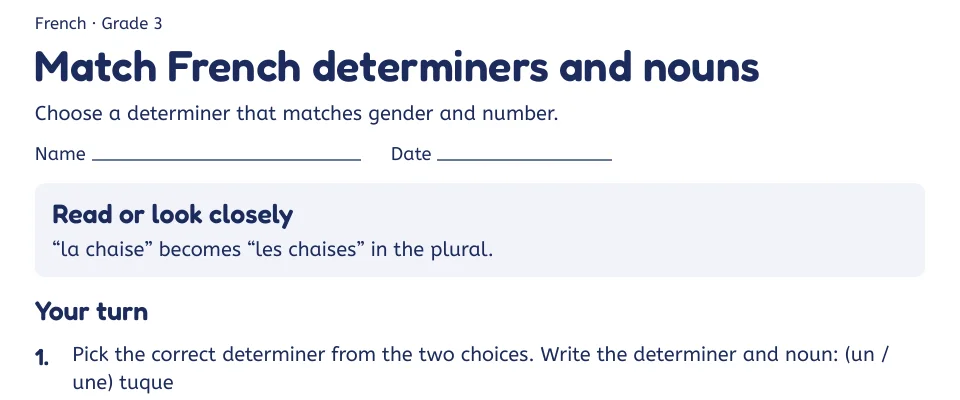
Choose a determiner that matches gender and number.
View exercise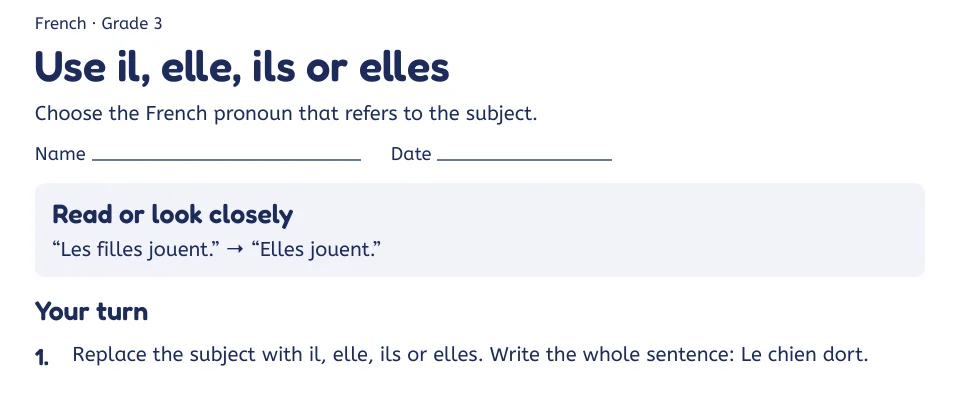
Choose the French pronoun that refers to the subject.
View exercise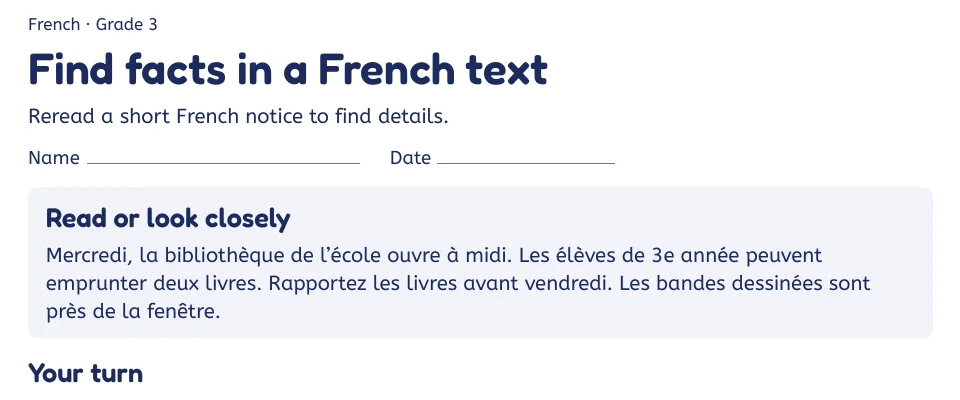
Reread a short French notice to find details.
View exercise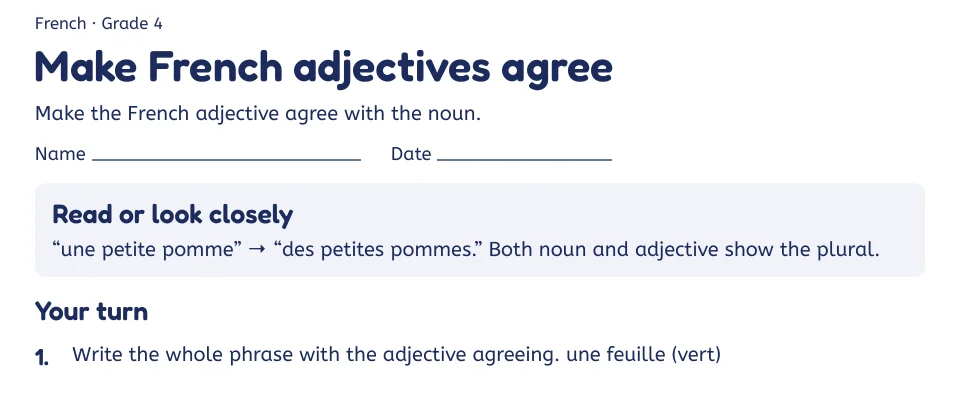
Make the French adjective agree with the noun.
View exercise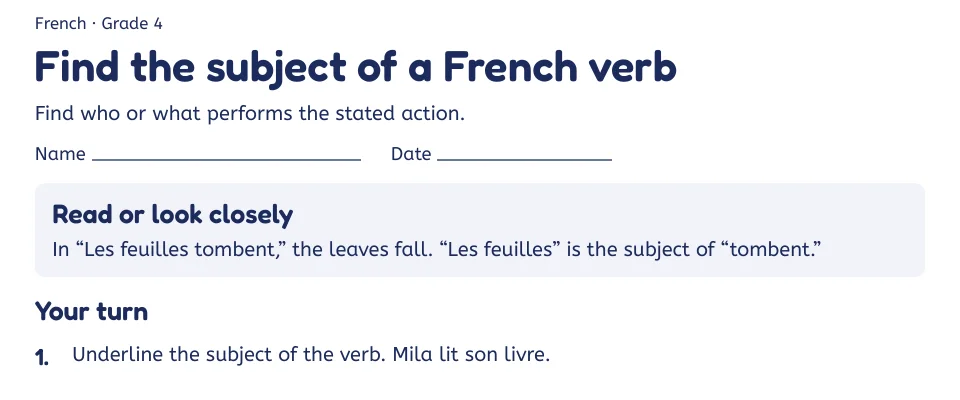
Find who or what performs the stated action.
View exercise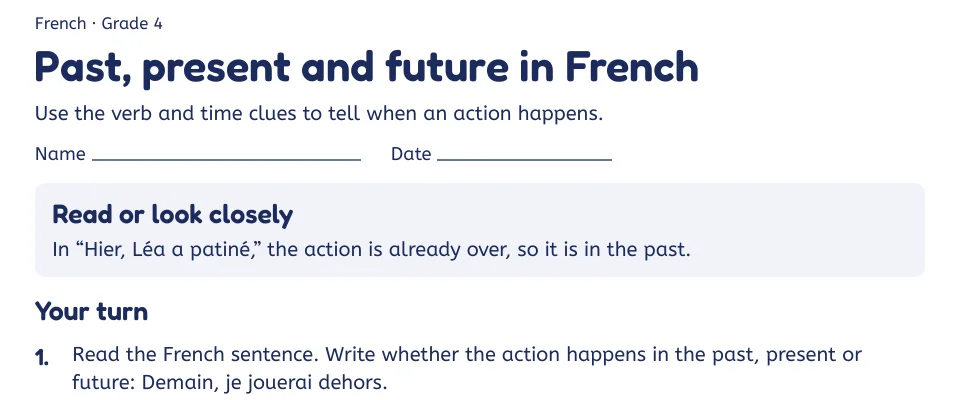
Use the verb and time clues to tell when an action happens.
View exercise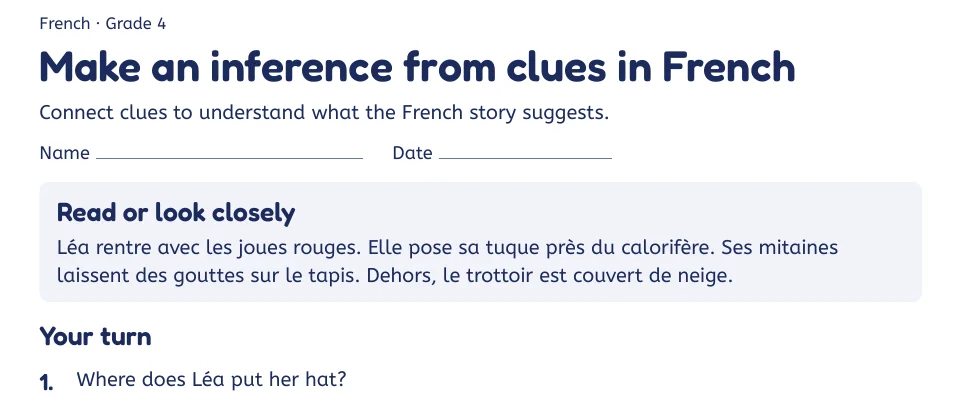
Connect clues to understand what the French story suggests.
View exercise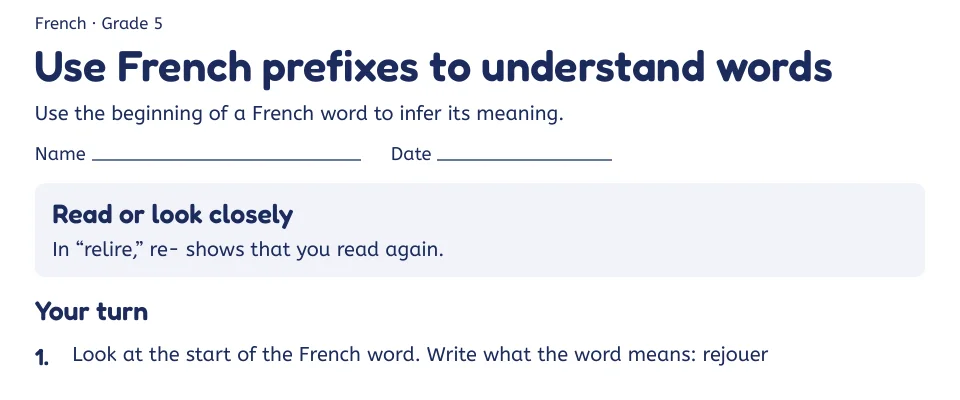
Use the beginning of a French word to infer its meaning.
View exercise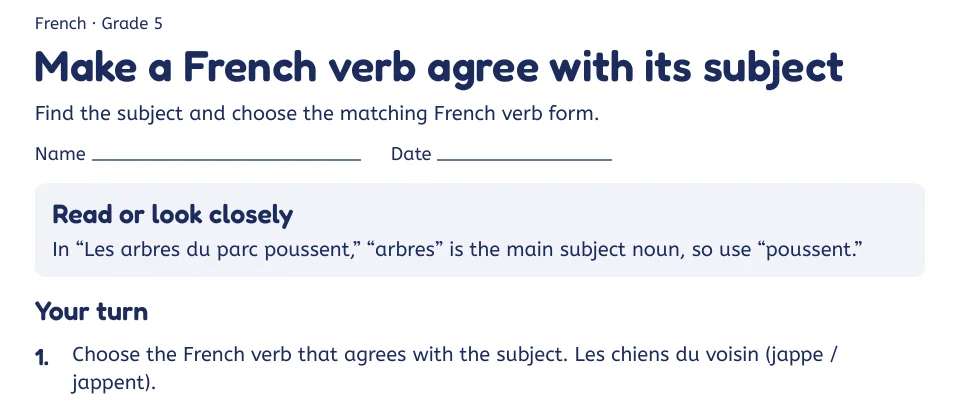
Find the subject and choose the matching French verb form.
View exercise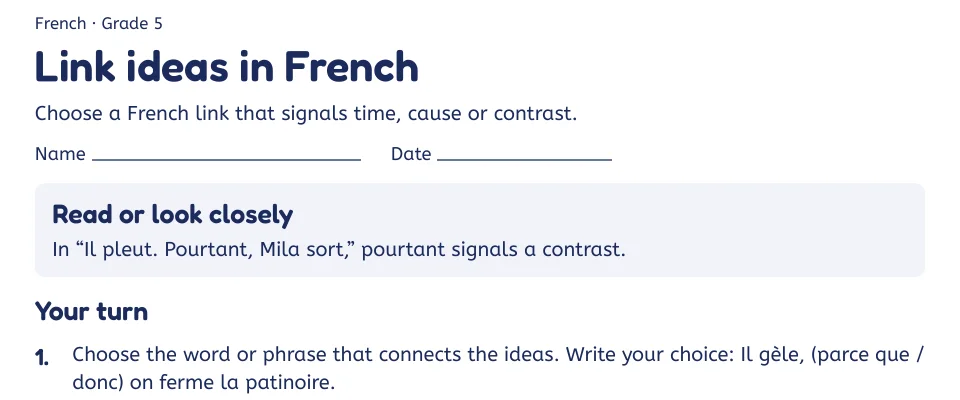
Choose a French link that signals time, cause or contrast.
View exercise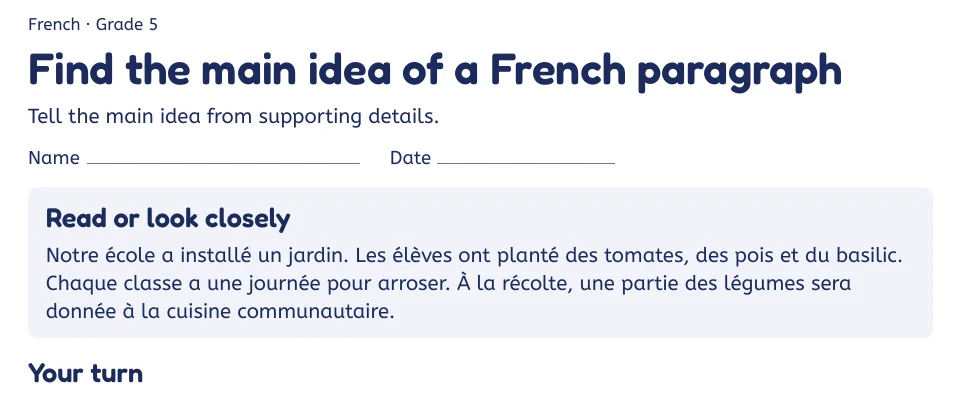
Tell the main idea from supporting details.
View exercise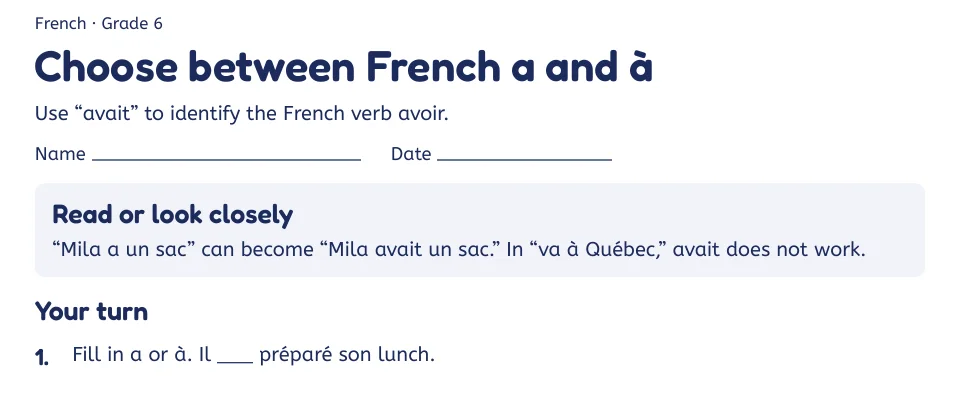
Use “avait” to identify the French verb avoir.
View exercise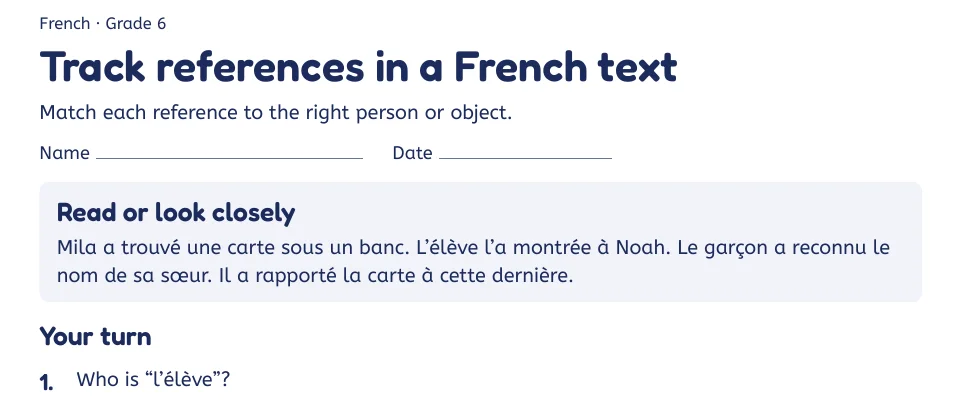
Match each reference to the right person or object.
View exercise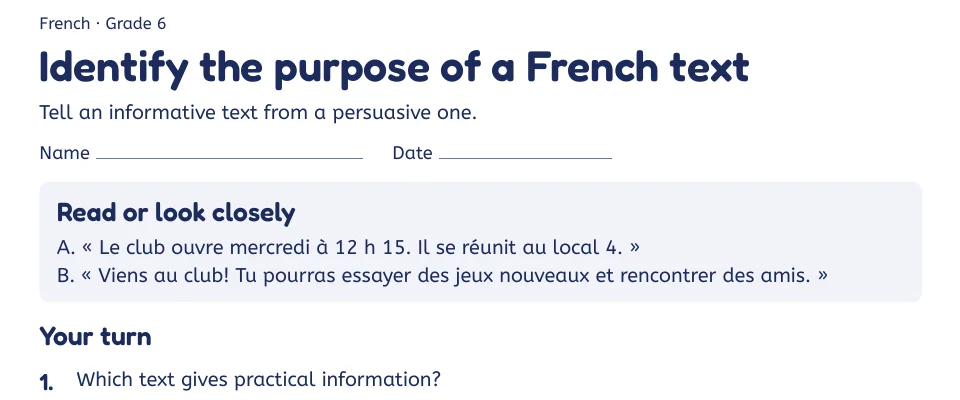
Tell an informative text from a persuasive one.
View exercise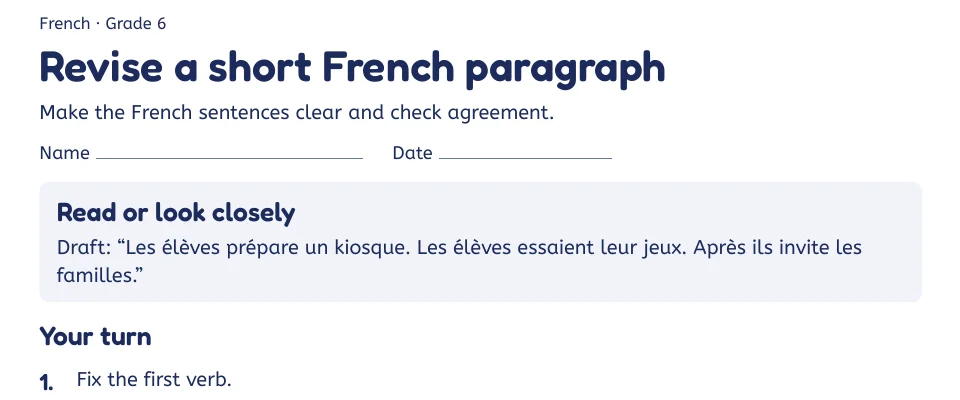
Make the French sentences clear and check agreement.
View exercise
Listen and respond to a greeting.
View exercise
Respond to a short instruction in English.
View exercise
Listen to colour words and point to matching objects.
View exercise
Match a number you hear to an amount.
View exercise
Listen and find classroom objects.
View exercise
Listen to instructions and do the actions in order.
View exercise
Listen for familiar words as a grown-up reads.
View exercise
Recognize words for how you feel.
View exercise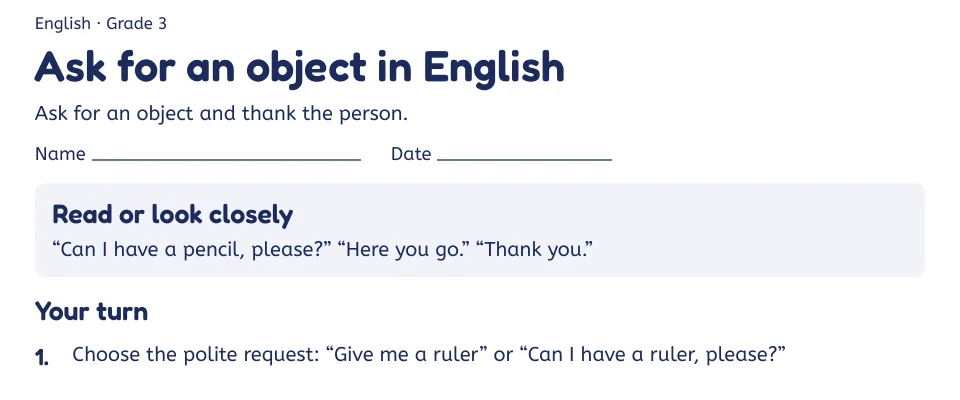
Ask for an object and thank the person.
View exercise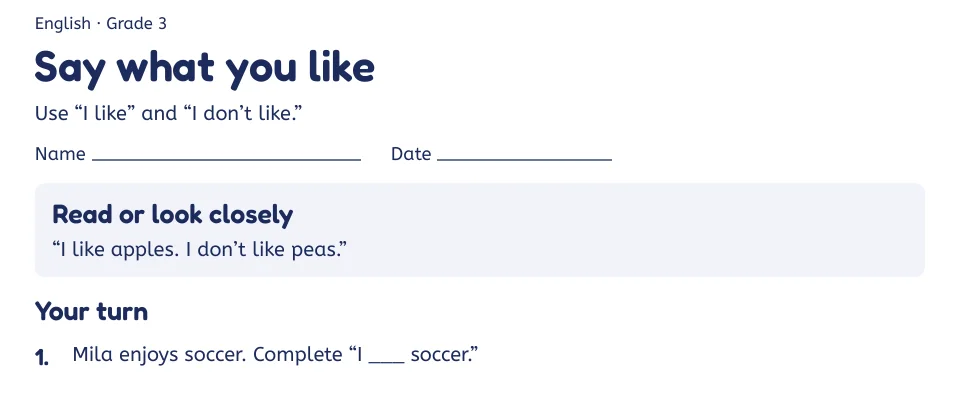
Use “I like” and “I don’t like.”
View exercise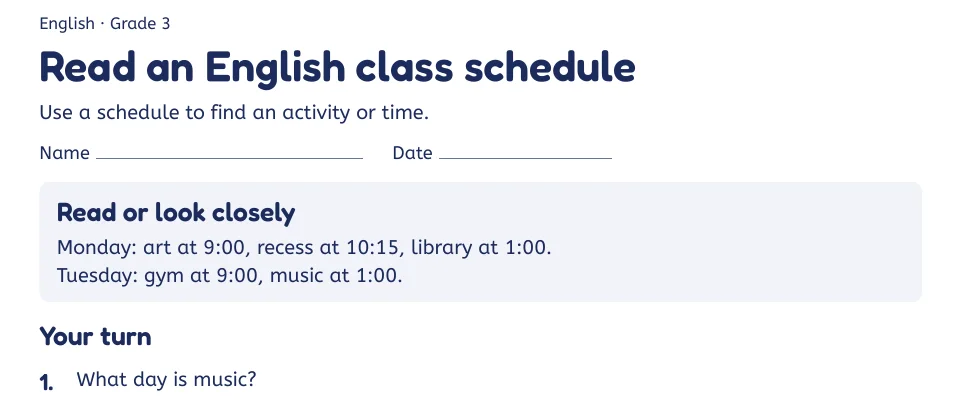
Use a schedule to find an activity or time.
View exercise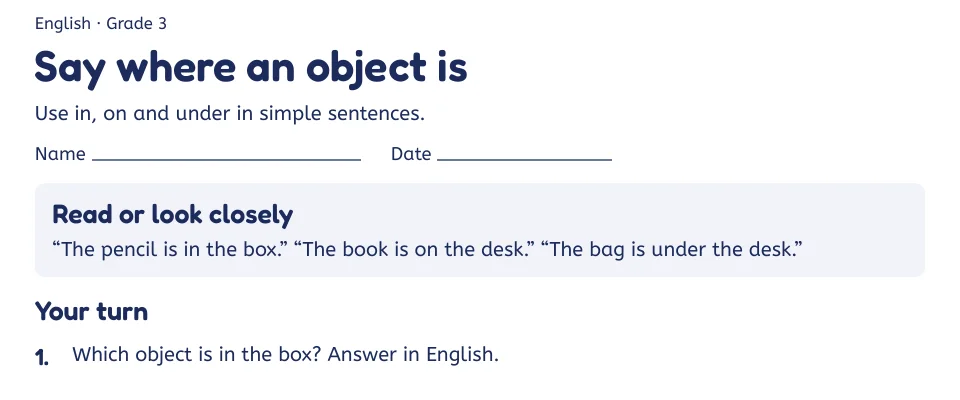
Use in, on and under in simple sentences.
View exercise
Put actions in order with first, then and finally.
View exercise
Recognize direction words in a route.
View exercise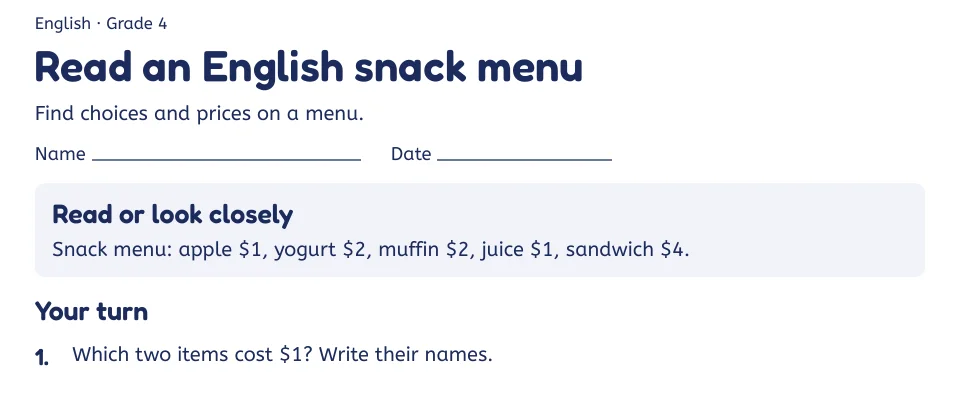
Find choices and prices on a menu.
View exercise
Write a short message with a greeting, a detail and a closing.
View exercise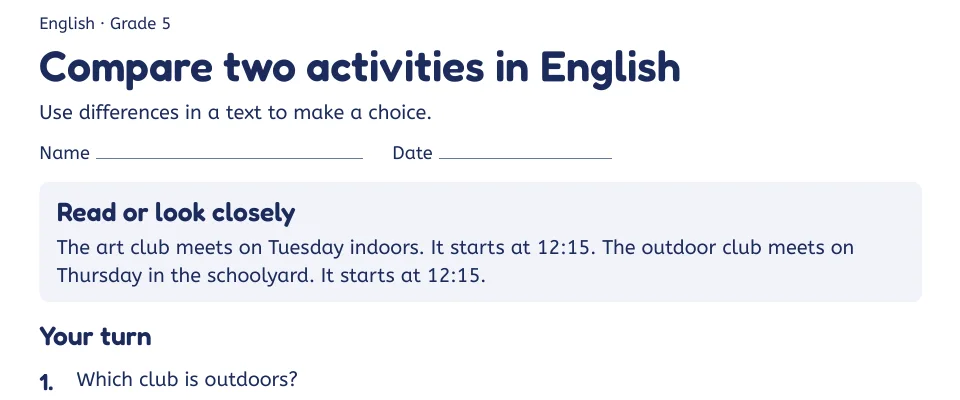
Use differences in a text to make a choice.
View exercise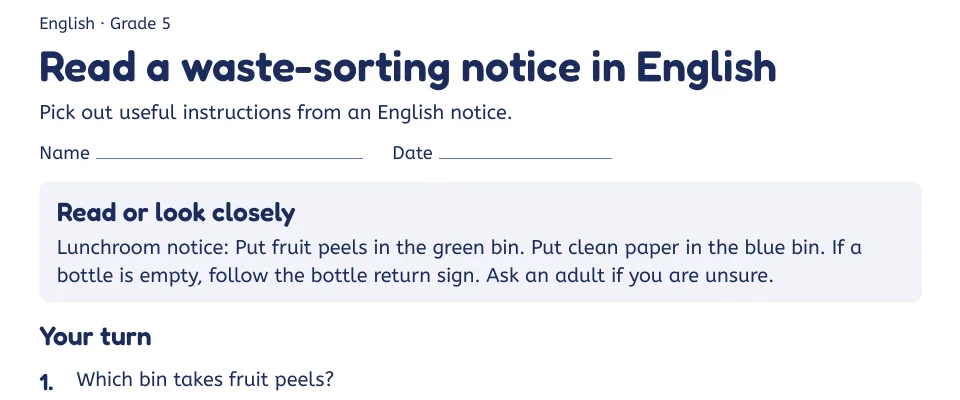
Pick out useful instructions from an English notice.
View exercise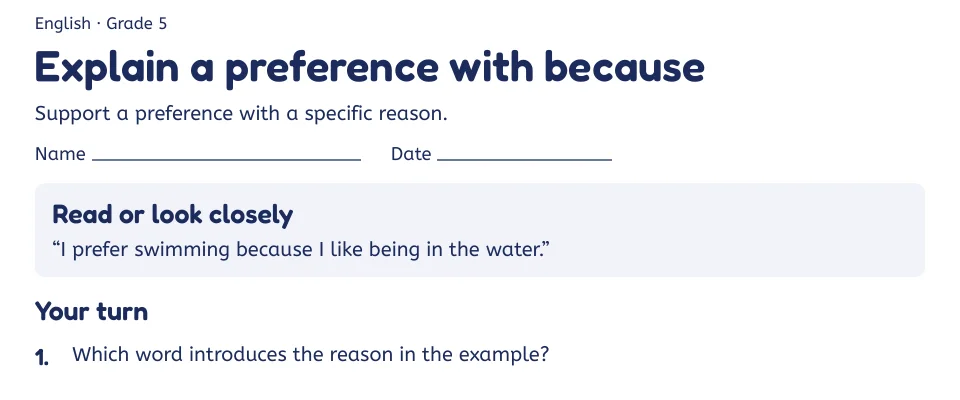
Support a preference with a specific reason.
View exercise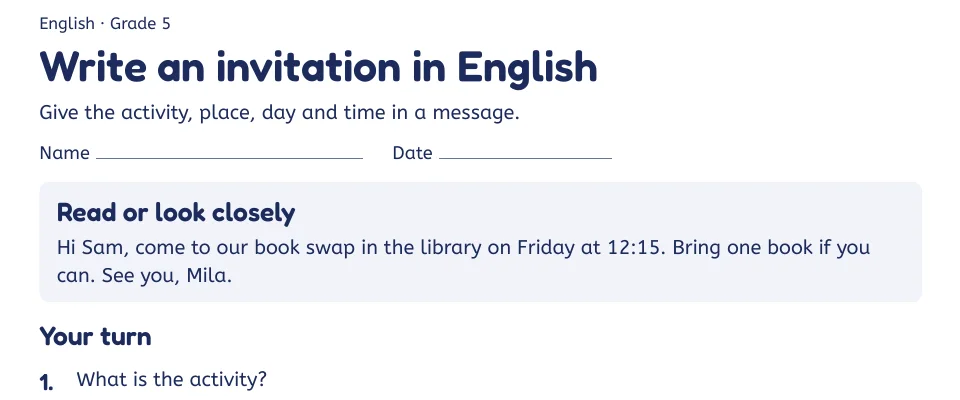
Give the activity, place, day and time in a message.
View exercise
Use details in a short English text to justify the main idea.
View exercise
Keep the problem, action and result when you summarize.
View exercise
Put steps in order and choose clear action verbs.
View exercise
State an opinion and support it with two reasons.
View exercise
Choose a sense to describe an observation.
View exercise
Name the material an object is made of.
View exercise
Use a clue to tell a living thing from a manufactured object.
View exercise
Describe the sky and precipitation from clues you can see.
View exercise
Match plant care to what the plant needs.
View exercise
Tell how a push or pull moves an object.
View exercise
Compare flexibility and how materials take in water.
View exercise
Compare observations of trees and weather across seasons.
View exercise
Classify water by its state.
View exercise
Identify roots, stem, leaves and flowers.
View exercise
Link a shadow to an object blocking light.
View exercise
Use Earth’s motion to explain day and night.
View exercise
Tell when liquid water becomes vapour and when it becomes liquid again.
View exercise
Read observations of magnetic attraction.
View exercise
Read the direction of arrows in a simple food chain.
View exercise
Connect phases to the lit portion we see from Earth.
View exercise
Choose how to separate components of simple mixtures.
View exercise
Link evaporation, condensation and precipitation in a model.
View exercise
Interpret temperature measurements during cooling.
View exercise
Use test results to compare two shapes.
View exercise
Connect an energy source or form to what a device produces.
View exercise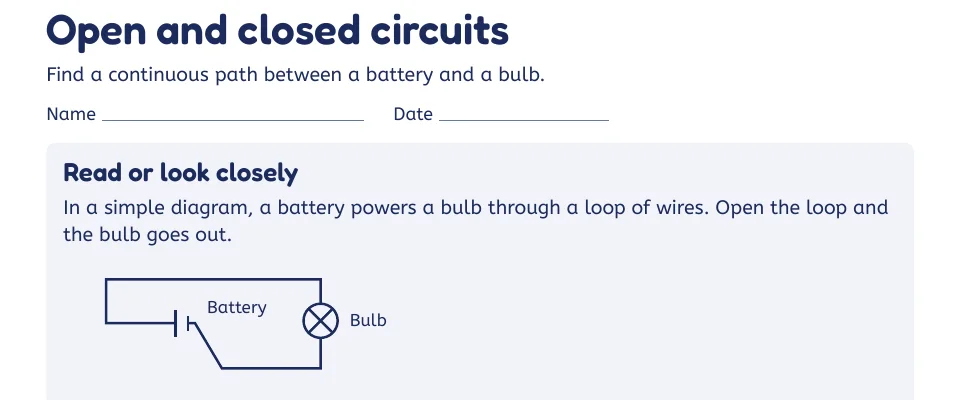
Find a continuous path between a battery and a bulb.
View exercise
Distinguish producer, consumer and decomposer.
View exercise
Choose one variable to change and factors to keep the same.
View exercise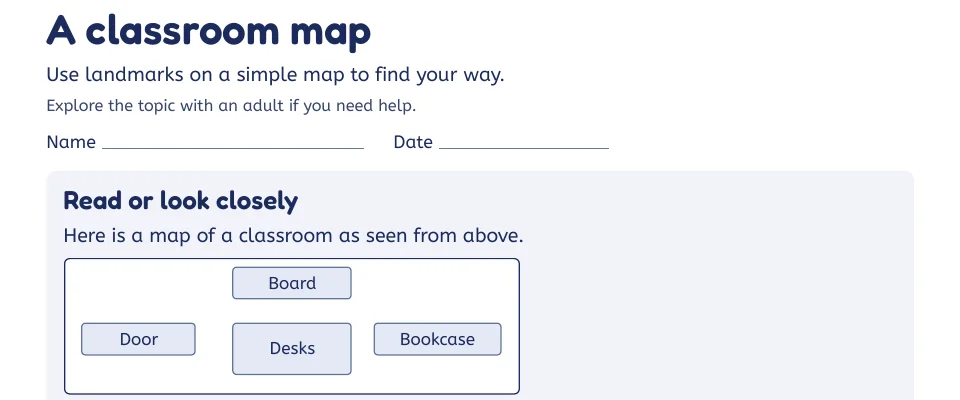
Use landmarks on a simple map to find your way.
View exercise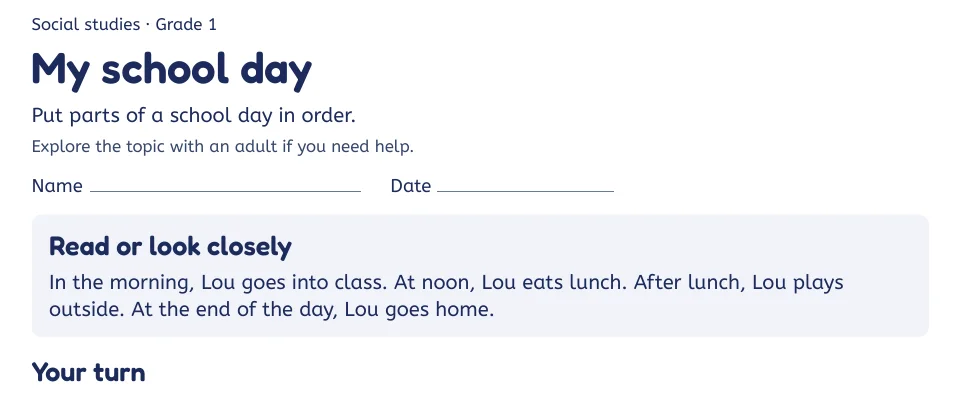
Put parts of a school day in order.
View exercise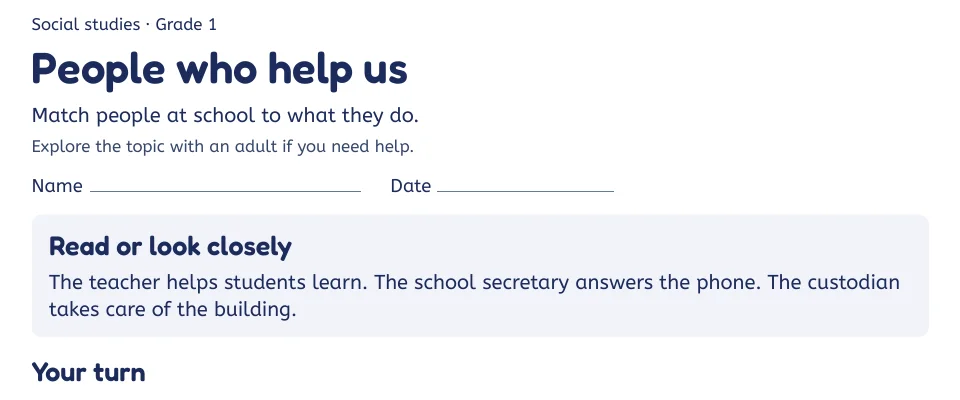
Match people at school to what they do.
View exercise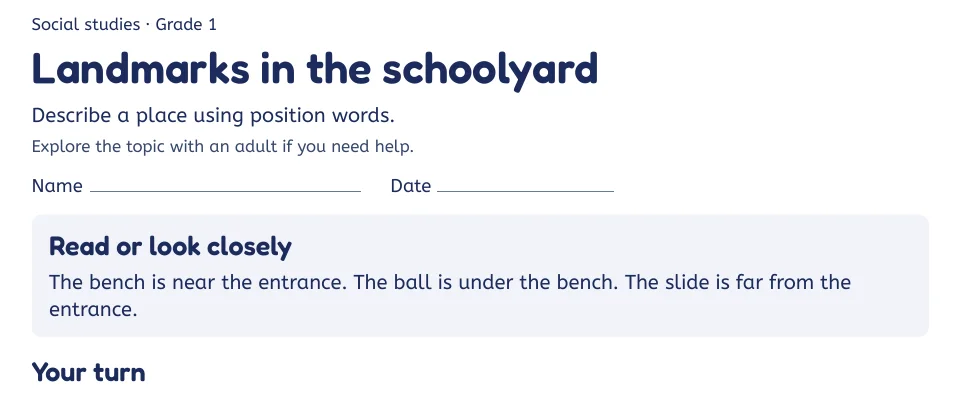
Describe a place using position words.
View exercise
Compare how people did things at two times.
View exercise
Find one change and one similarity in how people get around.
View exercise
Compare landmarks in two kinds of places.
View exercise
Use a timeline to put events in order.
View exercise
Describe the housing of Iroquoian communities around 1500.
View exercise
Identify crops and their role in food around 1500.
View exercise
Connect features of the land to the needs of an Iroquoian village around 1500.
View exercise
Explain what trading lets people get.
View exercise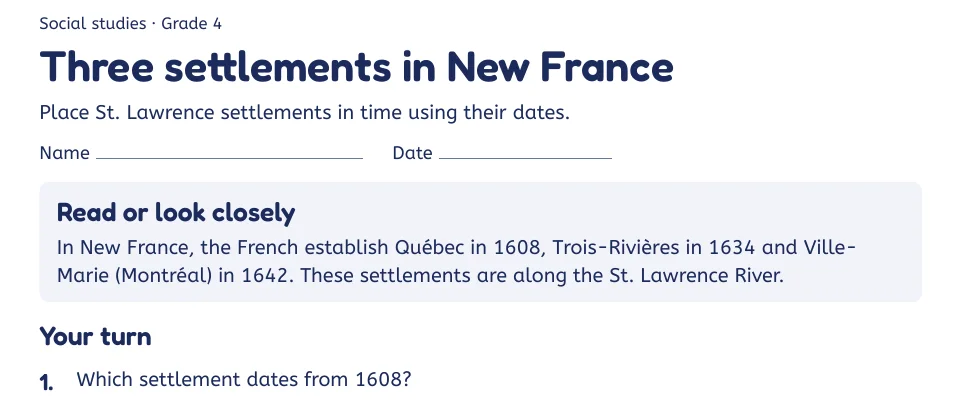
Place St. Lawrence settlements in time using their dates.
View exercise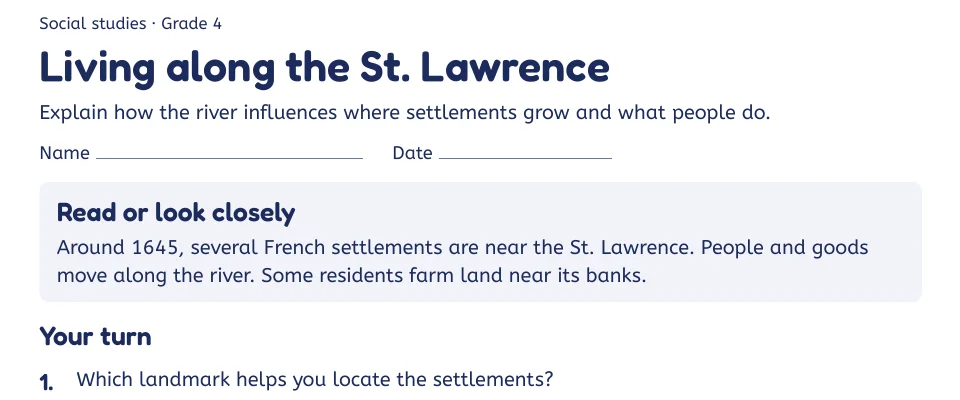
Explain how the river influences where settlements grow and what people do.
View exercise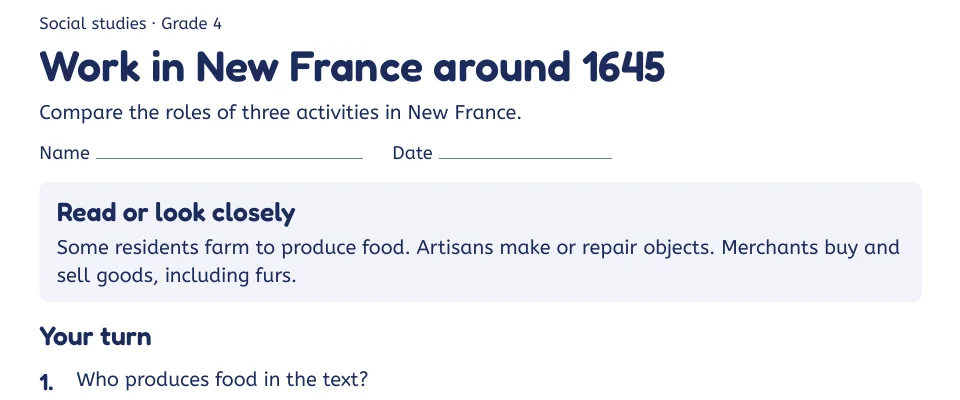
Compare the roles of three activities in New France.
View exercise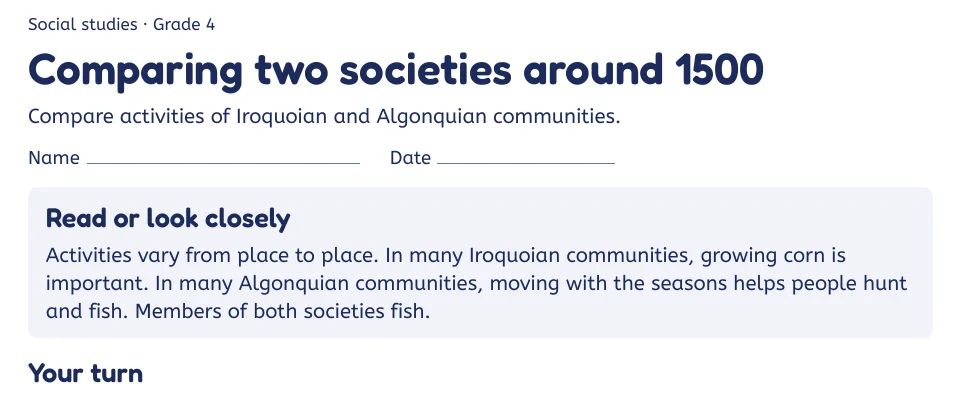
Compare activities of Iroquoian and Algonquian communities.
View exercise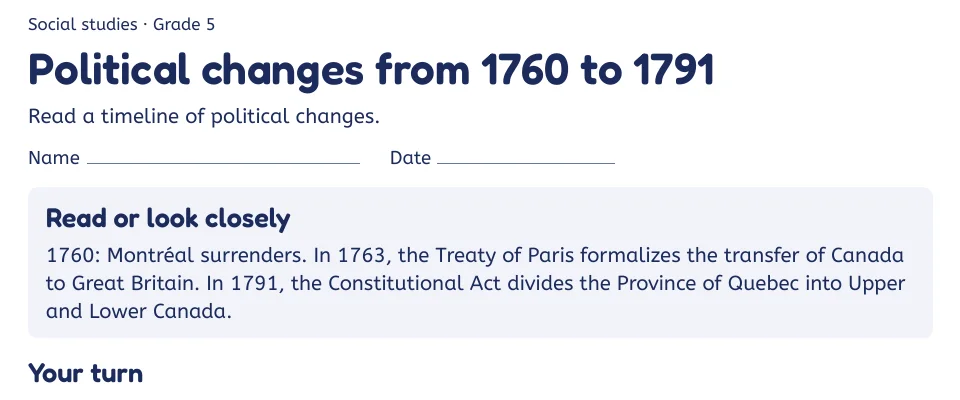
Read a timeline of political changes.
View exercise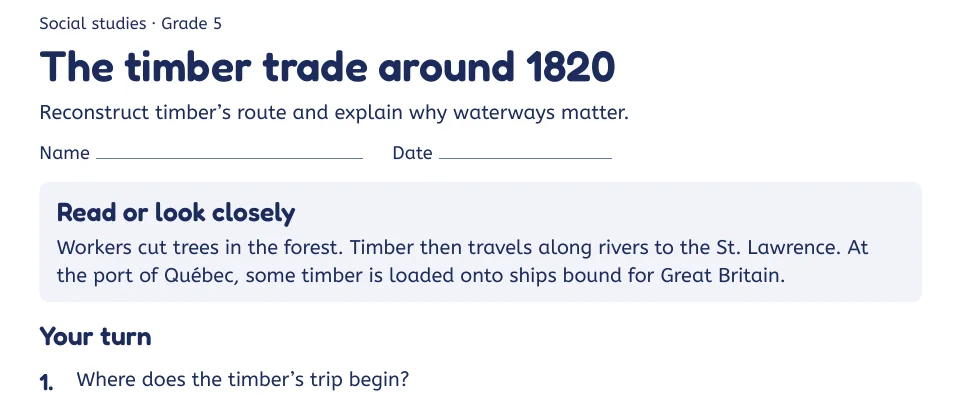
Reconstruct timber’s route and explain why waterways matter.
View exercise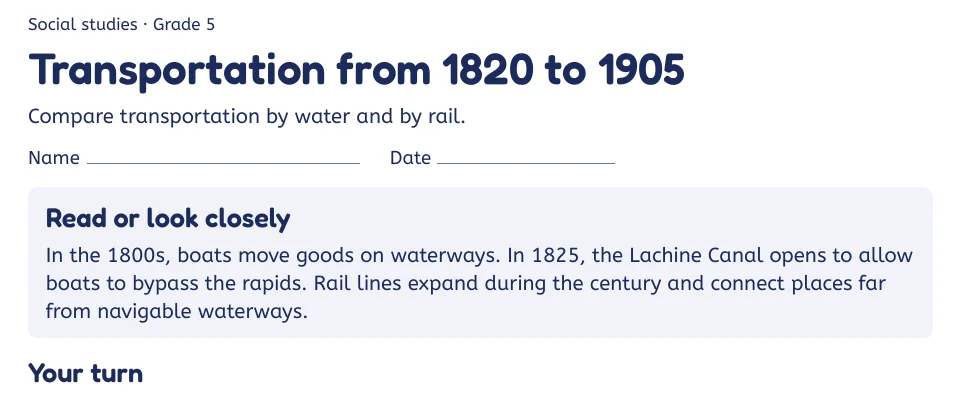
Compare transportation by water and by rail.
View exercise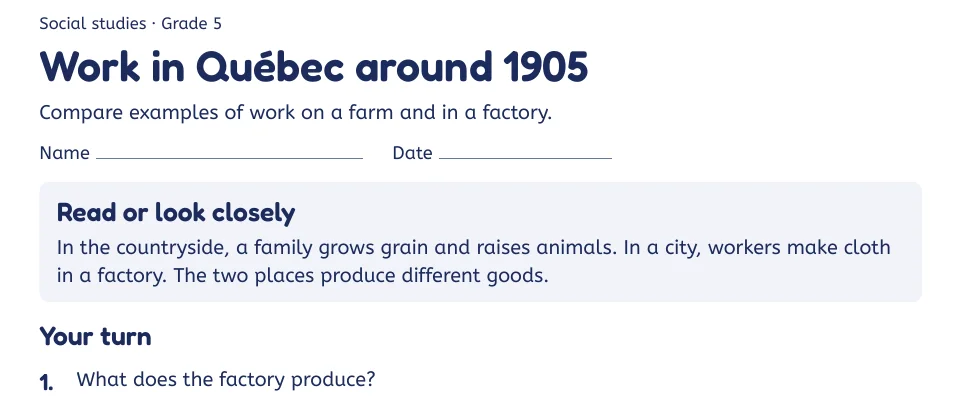
Compare examples of work on a farm and in a factory.
View exercise
Explain one change in Québec from around 1905 to around 1980.
View exercise
Connect changes in the school system to educational opportunities.
View exercise
Interpret two dates and distinguish federal from provincial elections.
View exercise
Identify changes and continuities in transportation.
View exercise