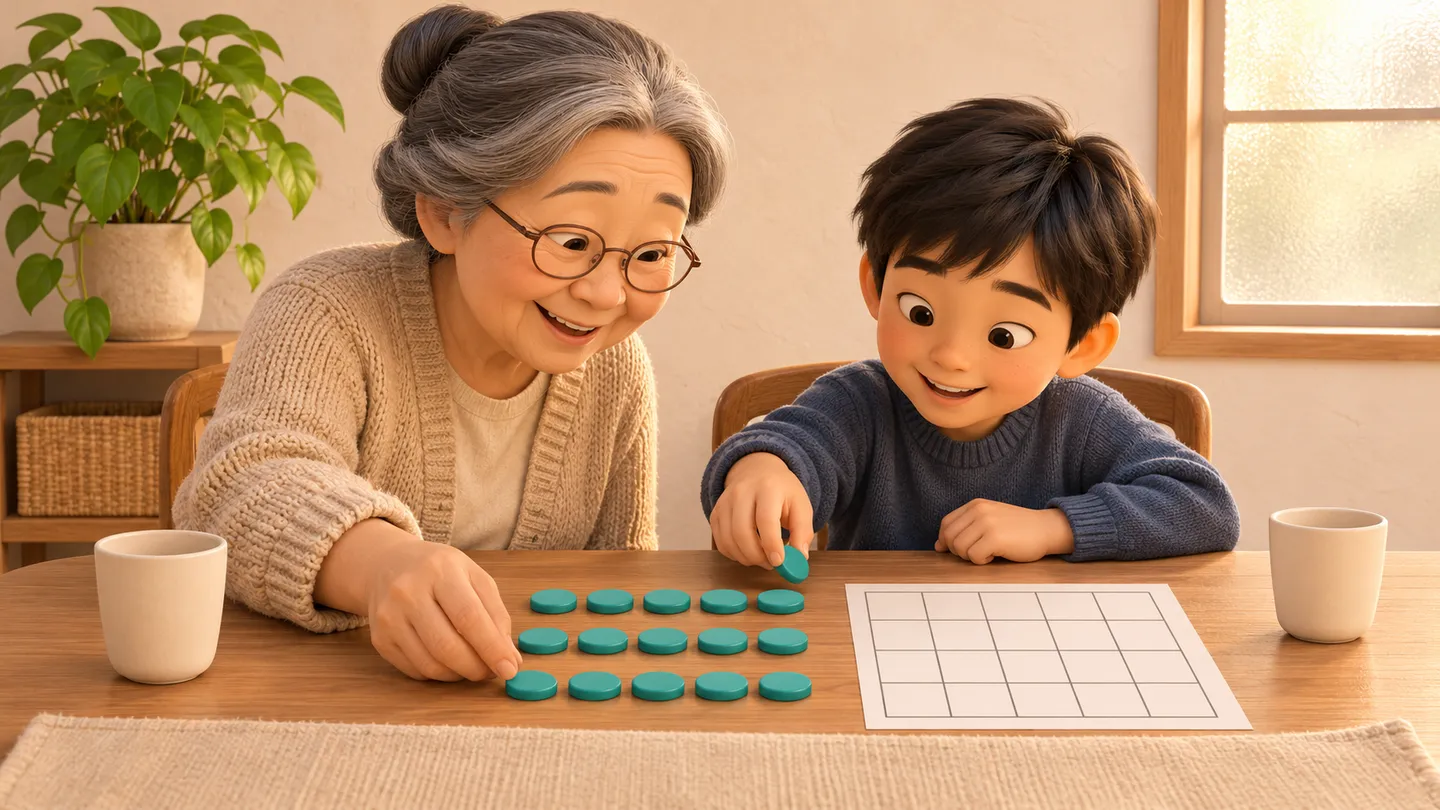


Perimeter is the distance around a shape. Area measures how much surface is inside it. To teach the difference at home, have your child trace a rectangle’s outline with a finger, then colour the squares inside it. On a centimetre grid, a rectangle that is 5 cm by 3 cm has a perimeter of 16 cm and an area of 15 cm². One number tells you the length of yarn that would go around the rectangle. The other tells you how many squares, each 1 cm on a side, would cover it.
Measure the outline and the inside on the same page
Get some grid paper, a coloured pencil and a piece of yarn that does not stretch. If the squares on your paper are not exactly 1 cm on a side, use units of length and square units for the activity. The side of one grid square is your unit of length; the whole square is your square unit.
Draw a rectangle 5 squares across and 3 squares down. Mark one corner with a dot. Ask your child to start at the dot, go around the edge and stop when they reach the dot again. They can lay yarn along the outline and count the short pieces of grid line that it covers: 5 + 3 + 5 + 3 = 16. For a rectangle, the shortcut is to add two neighbouring sides and double the result. Go around once before using that shortcut so your child can see why the two lengths appear twice.
Move the yarn away and colour the squares inside. There are 3 rows of 5, with no gaps or overlap. Your child can count all 15 squares, add 5 + 5 + 5 or multiply 3 × 5. On a centimetre grid, each square covers 1 cm². The Québec elementary mathematics progression covers perimeter under length and area under surface measurement.
Try the same yarn around three different pens
Imagine you are building a pen for toy animals. You have one piece of yarn for the fence and want to leave the animals as much floor space as possible. Draw these three rectangles using the same grid size. Before counting, ask your child to guess which pen they would choose and explain their pick.
| Size in squares | Perimeter in grid edges | Area in squares |
|---|---|---|
| 7 by 1 | 16 | 7 |
| 6 by 2 | 16 | 12 |
| 4 by 4 | 16 | 16 |
The 4-by-4 square offers the most space out of these three choices. To check, compare the outlines first. In every case, two neighbouring sides add to 8, so a full trip around measures 16. Then compare the insides by colouring one row at a time. For the square, both measurements happen to have the number 16. Ask your child to point out the 16 short edges and then to show you the 16 squares.
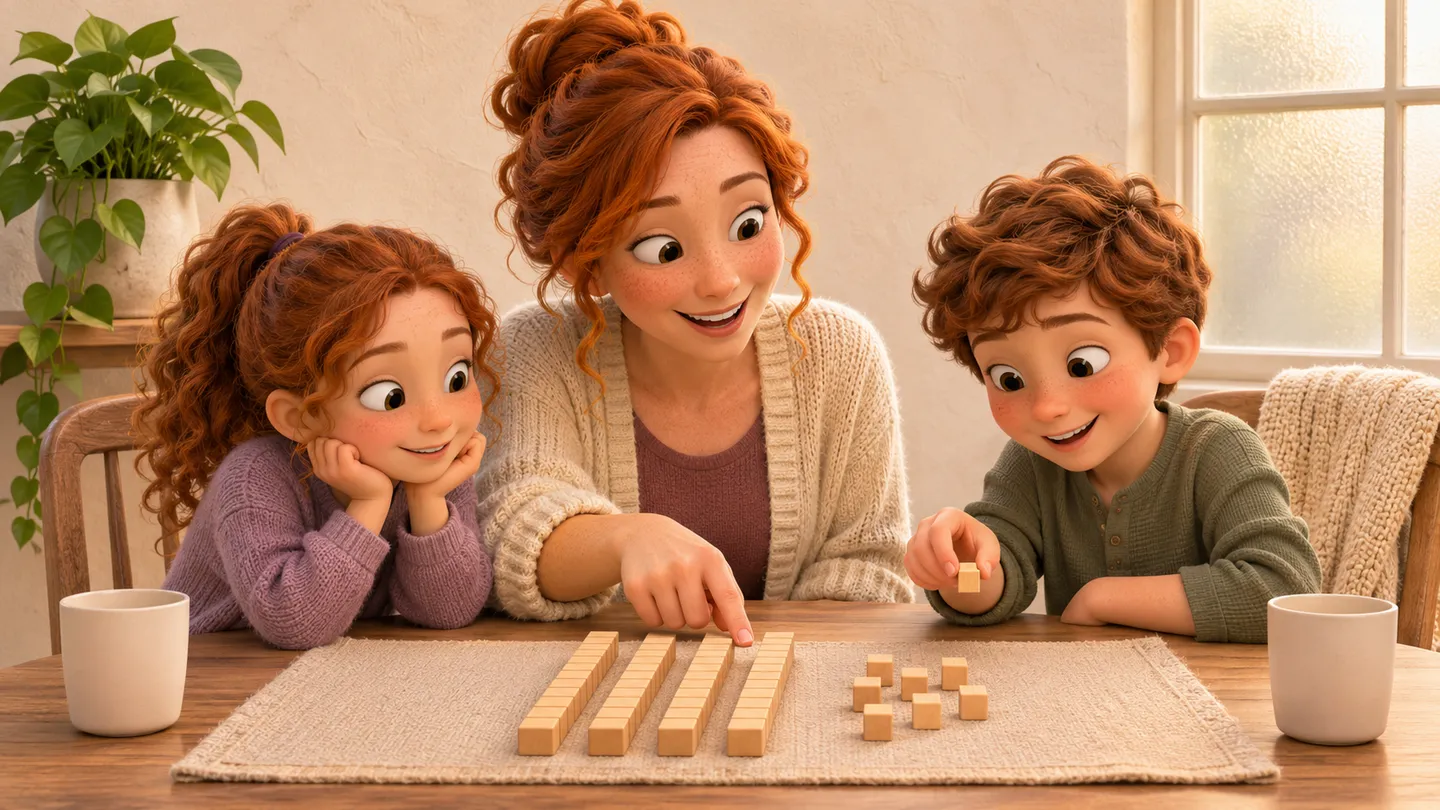
Now try the reverse. Cut or draw 12 identical squares and arrange them in 2 rows of 6, then in 3 rows of 4. The area stays at 12 square units, since you have moved the same squares. The length of yarn you need drops from 16 to 14 units. Ask which part of the old outline became an inside edge, or simply have your child trace both outlines to find where their lengths differ.
Five area and perimeter practice questions
- You want to put ribbon around a poster and cover the front with paper. Which measurement do you need for each job?
- A placemat is 8 cm by 3 cm. Find its perimeter and its area. Include the units.
- Two rectangular rugs measure 9 m by 2 m and 7 m by 4 m. Do they have the same perimeter? Which rug covers more floor?
- Draw a rectangle 3 squares across and 2 squares down. Remove the top right square. Find the area that is left and the new perimeter. Use the side of one square as your unit of length.
- You need a rectangle with an area of 20 cm² and side lengths in whole centimetres. Find two different shapes, then decide which would need less ribbon around the edge.
Answers
- The ribbon goes around the poster, so use perimeter. The paper covers the front, so use area.
- Perimeter: 8 + 3 + 8 + 3 = 22 cm. Area: 3 rows of 8 squares, which is 24 cm².
- Both have a perimeter of 22 m. The first covers 18 m², while the second covers 28 m². The 7 m by 4 m rug covers more floor.
- The area is 5 square units. The perimeter is still 10 units long. The two outer edges removed at the corner are replaced by two equally long edges along the new notch.
- For example, 10 cm by 2 cm and 5 cm by 4 cm both have an area of 20 cm². The first needs 24 cm of ribbon and the second needs 18 cm. Of those two options, the 5-by-4 rectangle needs less ribbon.
If your child still mixes up the two measurements
Cover the numbers and ask, “Can you show me what you want to measure?” If their finger travels around the outline, count lengths along the edge. If it sweeps across the inside, cover the surface with squares. Next, ask your child to write the unit before calculating. On grid paper, using one colour for the outline and a second for the squares makes it easier to check what was counted.
Next time, pick an object at home, such as a book, and make up two questions from the same sketch: one about the distance around its cover and one about the space the cover takes up. Let your child ask you the questions and explain which measurement they expect you to use. To practise deciding what a question is asking in other settings, see how to choose an operation in a word problem.